 Our latest BLOG (KL 01 March 2023 Pakistan March 15 2023 & UK-Netherlands 02/April 2023) & Liverpool (15 April) & England (June 08) ~ Blog Index
Our latest BLOG (KL 01 March 2023 Pakistan March 15 2023 & UK-Netherlands 02/April 2023) & Liverpool (15 April) & England (June 08) ~ Blog Index
Terrell Neuage- charting the ODAM (pdf) - University of South Australia teaching site
Conversational Analysis of Chat Room Talk PHD thesis by Dr. Terrell Neuage University of South Australia National Library of Australia.
THESIShome ~ Abstract.html/pdf ~ Glossary.html/pdf ~ Introduction.html/pdf ~ methodology.html/pdf ~ literature review.html/pdf ~ Case
Study 1.html/pdf~ 2.html/pdf~ 3.html/pdf~ 4.html/pdf~ 5.html/pdf~ 6.html/pdf~ 7.html/pdf~ discussion.html/pdf ~ conclusion.html~ postscipt.html/pdf~ O*D*A*M.html/pdf~ Bibliography.html/pdf~ 911~ thesis-complete.htm/~ Terrell Neuage Home
NOW AVAILABLE PUBLISHED 29/12/2017 FROM AMAZON
Constituting the ODAM (Online Discourse Analysis
Method)
Use of mixed linguistic analysis methodology
Finding strictly regulated language practices
Main feature of online talk: Open/Creative practices
Charting
ODAM
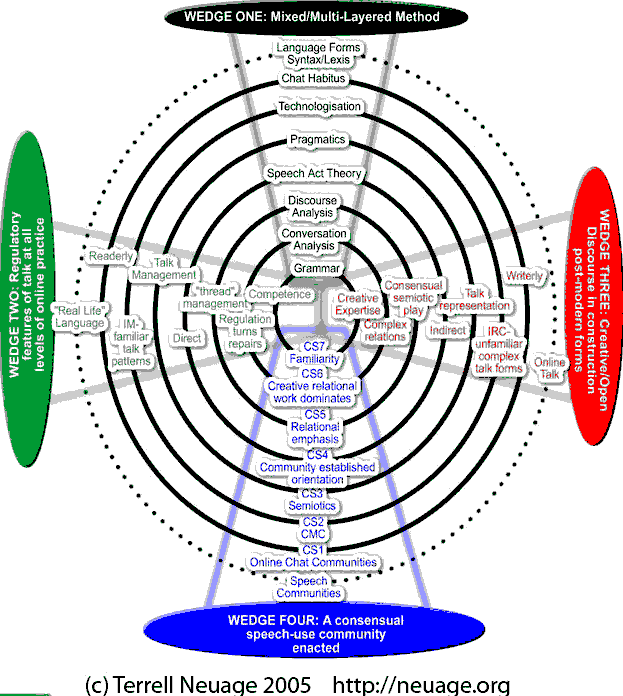
Building inwards from the broad user-perspectives of Reader Response, examining chat postings as actively received interpreted “wreaderly” communication, the ODAM has cut four deep and “rich descriptive” wedges from a multi-dimensional, multi-leveled set of chat actions. Beginning simply on an empirically driven arm: to cut into actual instances of chat practice using any existing research methods which could examine how online talk “works”. The study can now be seen to offer in the first instance, a set of interlocking research tools, any or all of which can be picked up, critiqued and re-applied, to be improved upon in future studies, by future researchers.
A second “wedge” or cut from the research findings however establishes that a key direction in linguistic research methodologies: the drive towards establishing the “regulatory” or rules-and-systems elements behind language use, is indeed given a different spin within online talk. Here it proves possible, again and again, from method to method – across the seven case studies “speech communities”, to reveal tightly regulated, recurrent and systematic talk practices, variant from those observable offline, even where there are equivalent interest or topic groups. Wedge 2 indicates those already established online practices which constitute the difference, and even expertise of online chat, this suggests that it may well be on its way to constituting its own “speech community/ies”.
But it is wedge 3: those descriptive features which reveal a markedly “open” or “creative” set of communicative behaviours online, which reveal how chat is being constituted. Here the evidence of complexity, semiotic and graphic play, consistent relational focus and creative expertise introduces the dynamic energy of online communication. Favouring members and strategies and expertise which reveal skill and creativity and fast-paced interpretive responsiveness.
Wedge 3 practices lead us on to the discourse-under formation of wedge 4 or discourse demanding continual enactment of familiarity, consensual strategies, relational work, and what CA would call “category maintenance” – of an exclusively “communal” kind.
Online chat, regardless of topic or the specifics of a participant group, appears directed to community itself. Not quite un-agentric as it dis-connects from action, it becomes meta-agentric: more about how to operate than about “what to do”, It is this, contrary to most contemporary public and media’s accounts, richer in value than in projects. It is a discourse largely about itself.
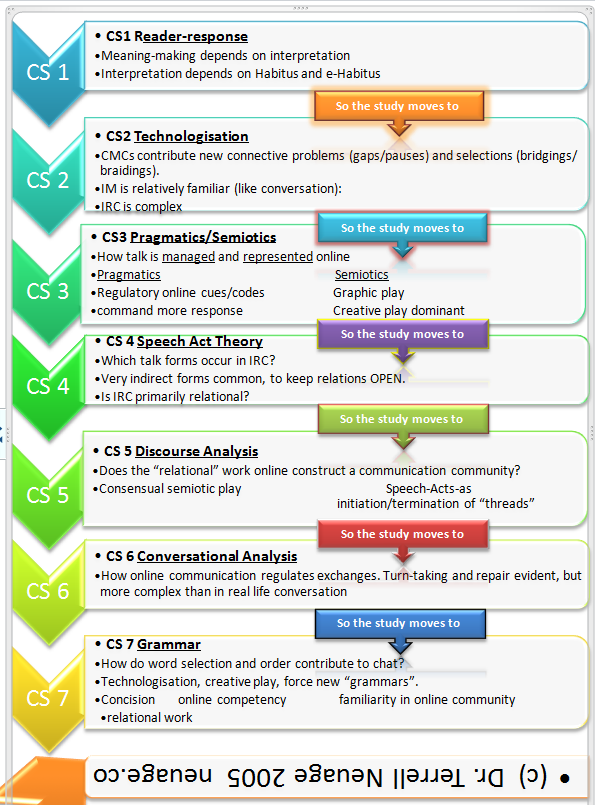
Having completed the seven differently-focused case studies designed to investigate these issues, it is now possible to see the quite distinctive directions these questions raise and the concomitant ways in which equally distinctive “clusters” of research focus have proven to have arise. The studies move from the fine focus of what can now be seen as technological and methodological questions (turn-taking; meaning-making; observational study) to a comparative emphasis cultural sensitivity in chat and in real-life talk; chat as reflective of real-life discourses; chat in comparison to natural conversation to the “postulatory” emphasis of much broader questions (chat as a useful area for new conversational research theory; chat as a new universal language). My own preliminary thinking indicated a three part study program, moving from existing linguistic-based observational and analytical methods, to an empirical evidence-founded description of actual online “talk” practice, and so to a deeper and richer set of hypotheses relating to online “chat” practices and behaviours. The study has thus begun the first stage of a methodological design for the study of chat – and perhaps of its future technologisations. The ODAM or Online Discourse Analysis Method proposed at the outset has evolved across the seven constitutive Case Studies:
5.3 Research
Questions and answers
Having revealed them both a tendency towards community-specific chat behaviours and at least the foundations for “chat universals”, it is time to revisit the research questions which orginally drove this project. How have they contriubted to, or contrained the findings? The five initial focus areas for this study were as follows:
Added to these mixed and incommensurable questions were an equally multi-level listing of my then-current assumptions on online communication:
Terrell Neuage 2005
ACKNOWLEDGEMENTS Leigh Neuage 6th July 1983 - 16th August 2003 every place I go I go with you ~ thanks for being always with me always. I only wish I could be with you. Everyday is more difficult than the one before. 04 September 2010.
Leaving Australia 'Again': Before the After 353 pages from $4.25
Leaving Australia, 'Again’: Book 2 ‘After’ 513 pages from $2.99
picture poems from many decades ago pre-post-noir Neuage
#Thoughts in Quarantine & Before - Images: updated Pinterest ~ Flickr (2020) / Flickr (pre-2019)
#OurCurrentLifeWithCovid/War in Europe
#DailyThoughts Adelaide, South Australia
Blogs of Travel 2018 - 2022: Book 2 ($2.99 845 pages)
Blogs of Travel 2016 - 2018: Book 2 ($2.99 852 pages)
Blogs of travel 2002 - 2014: Book 1 ($2.99 837 pages)
slideshow upclose of Pakistan life 2022covid/world war 3 tour VIDEO HITS > 2021-2022
BLOG - Covid World Tour 2021~ 2022
MY Banned books in Oklahoma
contact me ~ My Resume Follow @neuage Tweet to @neuageLeaving Australia 'Again': Before the After Read the first 45 pages for free
available on these devices (Amazon author page)
All Images of picture poems Terrell Neuage (Adsit)
lots of picture poems of late over here at pinterestBlog & new ramblings on substack
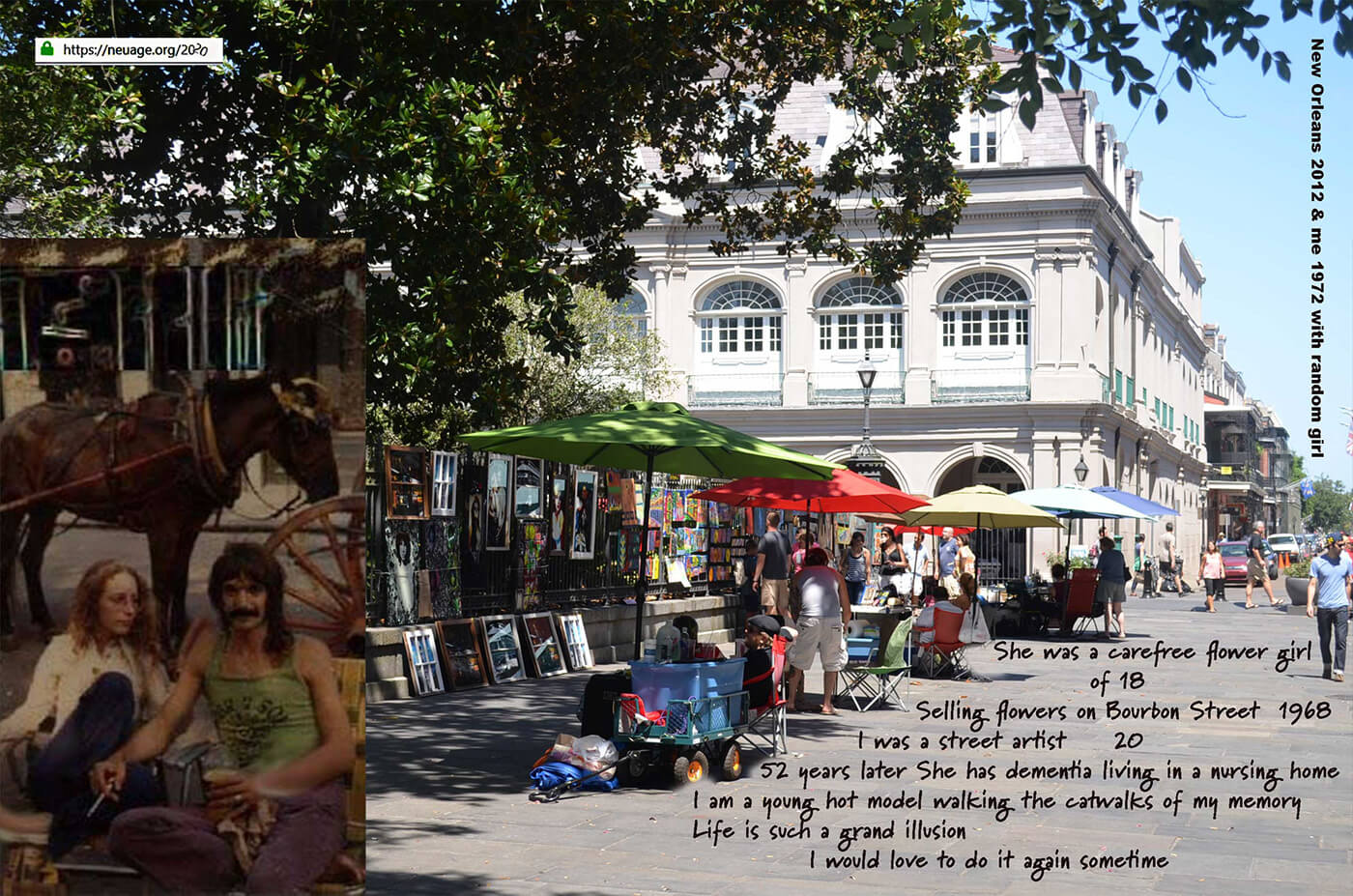
PhD thesis > '"Conversational Analysis of Chatroom Talk": Online Discourse Analysis' Method' Kindle EditionShe was a carefree flower girl of 18
Selling flowers on Bourbon Street
1968
I was a street artist...
current books by Terrell Neuage
how we see the world today 2021 ~~ neuageVIEW twenty years and more agoiso ties ~ LAST DAY/TIEs ~ Behance
ties in isolation - the movie /#TerrellNeuage PhD
traveller, explorer, writer, photographer, digital artist, neighbour
index
sitemap
advanced
TOFU DALIAN
I threw away my umbrella
As far as the song we sing
Tree - the story
Pick a dream and stay awake in itA few of my social sites that I post to every hour... being a private person I have only listed a few of ones I am willing to share - what about you?
Youtube,
Wordpress (blog),
Facebook,
Twitter ,
Instagram ,
Linkedin,
Pinterest,
Mastodon
Tribel,
Post
spoutible
TikTok
WT Social,
Amazon by Terrell,
myportfolio,
Behance
substack,
vimeo,
deviant art,
Flicker,
Books 2 Read,
Wimkin,
Daily Motion,
ePub,
Polywork
Live Journal,
Foursquare,
Screencast,
Caffeine,
Goodreads,
coderwall,
github,
Hacker News,
Medium,
MeWe,
fiverr,
Kakao,
Skyrocket,
MIX,
Pathbrite,
MustRead,
MySpace,
Tripod
Parler
9GAG
WikiTribuneSocial
MyPBworks
Patreon
Plurk
Minds
Gettr
Webnode




 tumblr
 gab
gab Quora
Quora reddit