Conversational Analysis of Chat Room Talk PHD thesis by Dr. Terrell Neuage University of South Australia National Library of Australia.
THESIShome ~ Abstract.html/pdf ~ Glossary.html/pdf ~ Introduction.html/pdf ~ methodology.html/pdf ~ literature review.html/pdf ~ Case
Study 1.html/pdf~ 2.html/pdf~ 3.html/pdf~ 4.html/pdf~ 5.html/pdf~ 6.html/pdf~ 7.html/pdf~ discussion.html/pdf ~ conclusion.html~ postscipt.html/pdf~ O*D*A*M.html/pdf~ Bibliography.html/pdf~ 911~ thesis-complete.htm/~ Terrell Neuage Home
Change create to adopting different textual selves
5.0
Findings of Case Studies 1- 7
5.2 Research Questions and answers
5.2.1
Is turn taking negotiated within chatrooms?
5.2.3 Will
chatroom discourse become a universally understood language?
5.2.4
How is electronic chat reflective of
current social discourse?
5.2.5
Is meaning communicated within Chatrooms?
5.3 Assumptions at the beginning
5.3.2 That
conversation within chatrooms will change how we come to know others.
5.3.5 That
'chat' does not differ from natural conversation.
5. Discussion
|
|
Chatroom communication follows in the steps of many forms of human communication from crude grunts and hand signals to the development of complex system of spoken words and visual symbols relayed through hieroglyphs, yelling, speaking, smoke signals, ringing a bell or physically transporting a message between two places. The Internet is the most recent advance in communication. It allows us, in a split second, to disseminate a seemingly limitless amount of information throughout the globe in a way of turn taking in conversation where there is not an immediate dominance of culture, gender, philosophy, nationality or age. What I have found by using several linguistic theories in seven case studies is that online communication in a chatroom has both similarities and differences to oral and written communication.
This study was undertaken during a specific period of
Internet history, from 1998 to 2001. The Internet had its start in September
1969 when two computers were hooked up and the first computer-to-computer chat
took place at the
I chose a thematic plan of using conversational theories as my methodology to investigate chatroom talk. The theories that I have used in relationship to the Case Studies are:
· Reading-response Theory (Case Study 1),
· Computer Mediated Communication (Case Study 2),
· Semiotic Analysis (Case Study 3),
· Speech Act Analysis (Case Study 4),
· Discourse Analysis (Case Study 5),
· Conversational Analysis (Case Study 6), and several linguistic theories relating to discourse theories and
· Linguistic schools of thought, which explore grammar in conversation and the construction of meaning, such as the Prague School of Linguistics (Case Study 7).
5.0 Findings of Case Studies 1- 7
The findings in these case studies looked at discourse in chatrooms using a number of selected linguistic methods for analysis. Firstly I will summarize the most explicit findings in each study and then compare the seven studies, as well as observations from within five other chatrooms, to show features most common to all text-based chat, and generalisable as the ‘core’ discursive modes of Internet chat. Despite their often incommensurable focus, the range of the theoretical methods used for analysis revealed particular communication features common to all chatrooms. Most of these features are not part of person-to-person offline talk, and therefore are unique to text-based chatroom dialogue.
The purpose of the case studies and supplementary chatroom data ‘captured’ was to answer the five primary research questions in my methodology section (3.3) which I will discuss individually below:
Is turn taking negotiated within
chatrooms? If yes, do the rules differ from live speech, and if yes, how?
With the taking away of many
physical identifying cues of participants (gender, nationality, age etc.) are
issues of sex, race, gender, class, age, and political correctness as prevalent
as in face-to-face talk? If yes, how are these matters signaled, read, and
negotiated? If no, what are the consequences of abandonment of social sanctions
existing elsewhere?
How is electronic chat reflective
of current social discourse?
Is meaning contractible within
Chatrooms? If yes, how does this occur?
Could chatroom
discourse become a universally understood language? If so, what might it add to
existing language behaviours?
These five were posed to question my five assumptions at the beginning of my methodology section (3.2):
- That people adopt ‘textual self’ for
each chatroom environment they are in,
- That conversation within Chatrooms
will change how we come to know others,
- That observational study of chatroom conversation can capture some of the
adaptations of conversational behaviours,
- That this work gives us a better
understanding of how, and why, Chatrooms are an important area in which to
create new conversational research theory.
- That 'chat' does not differ from natural conversation in certain key aspects.
Each case study had three components useful in bringing about conclusions of chatroom analysis. The first component was the theory used to identify how text-based chat ‘worked’. Secondly, each case study identified features of conversation that were unique to text-based chatrooms, and thirdly each case study allowed for the analysis of chatroom behaviours demonstrating elements of communicative activity specific to the theory driving that particular case study. In other words, both general and specialised features were pursued in each case study.
In summary, the primary discoveries in each case study provide a map of IRC, in both general and specific terms, across a broad spectrum of exemplar behaviours, at least during the sample period, and most likely beyond.
CS 1
In Case Study
1 the research tool for analysis was Reader-Response theory, a field which
enabled the discovery that in online chat, both the person writing and the one
(or many) reading are co-language-meaning creators. Chatrooms are an active
reading environment where the ‘reader is left with everything to do…’ (Sartre, 1949, p. 176). In order to engage in conversation the
‘speaker-writer’ needs to be a ‘listener-reader’. What is open in chatrooms that is not
available in person-to-person conversation is what later commentators called
“preferred readings” what may be represented in the
text as 'an inscribed reader' or may emerge in 'interpretative communities'. (
Using Reader-response theory I found that there are two
actual moments of reading a participant takes in understanding meaning within a
chatroom before beginning to read the actual
utterances of the other chatters. In person-to-person conversation early
readings of someone else before we listen to what he or she speaks involve
viewing the person, their appearance, their posturing, body language and the
environment. (see, McCroskey
and
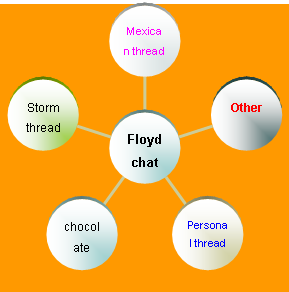
Firstly, the title of the chatroom is read. In Case Study 1 I found that the chatters carried on conversations that were reflective of the chatroom title of Hurricane Floyd. In other Case Studies I found the same reading techniques used. In other words speakers tend to converse about the same topic as the chatroom title. I discuss this later in 5.2 where I show the commonality between chatrooms. In chatrooms the reader’s response fits with the chatroom milieu. There can be a new writing that begins a new thread in a chatroom with the response dependent on the reading. For example in Case Study 1 turn 107 <SWMPTHNG> inquires <YOU AINT TALKING ABOUT MEX ROOFERS ARE YOU?> in assumed response to turn 99 <EMT-Calvin> <folks need to be careful for con artest after the storm>. This reading is still on the same topic of the storm as a thread alongside topics about the storm itself. There are few threads during this conversation that are not directly on the storm Hurricane Floyd. Below shows that 254 of the utterances in this chatroom are directly on the storm, 14 turns are about whether Mexican roofers will become involved with rebuilding after the storm, seven turns are personal , for example, <your last name wouldn't be Graham would it> and several turns had nothing to do with the topic of the storm for example, <AND PRUNE JUICE....DON'T KNOW IF I'M COMING OR GOING.....> and <ankash> stating I gotta go get some Xanax.>.
|
Thread |
Example |
Number of turns in thread |
|
Storm
thread |
Turn4
<TIFFTIFF18> DO U MOW IF ITS GONNA HIE
|
254 |
|
Mexican
thread |
Turn77 <SWMPTHNG> THERE'LL BE PLENTY OF MEXICAN
ROOFERS IN N CAROLINA NEXT WEEK |
14 |
|
Personal
thread |
Turn189 <guest-Beau> Calvin, your last name wouldn't be Graham would it |
7 |
|
Chocolate
thread |
Turn15 <mahmoo> brb.......gotta go get me some chocolate |
6 |
|
Other |
Turn215 <guest-Capt> VIAGRA AND PRUNE JUICE....DON'T KNOW IF I'M COMING OR
GOING..... |
6 |
The
illustration below shows the threads branching out from the primary thread. The
primary thread is all that relates directly to Hurricane Floyd (Mexican thread,
Storm thread) and the secondary threads are the three other threads shown
below. Secondary threads can be about the primary topic but are not as apparent
as to continue the primary topic. Secondary threads, if added to at length
could then become primary threads. A secondary thread becomes a primary thread
when most of the participants in the chatroom
contribute only to that thread such as the ‘talk’ about the storm – its
location, strength, destruction[3] and the
thread about Mexican workers who will offer to re-roof damaged properties.
In Case
Study 1 I was looking to discover whether topics of conversation were based on
the title of the chatroom. Here, I found that the writerly-writer who initiates a conversational thread, and
the writerly-reader who responds, could be shown to
demonstrate especially “open” and “active” strategies of initiating text and
responding to it based on the title of the chatroom. In the example below <TIFFTIFF18>
in captured-turn 4 enquires whether the hurricane is going to hit
One of
the features of ‘Reception and Reader-Response Theory’ as I am using it in
chatrooms is that it shows how a reader brings certain assumptions to a text
based on the interpretive strategies he/she has brought to a particular
community, from other social-cultural contexts (See, Gass, Neu, and Joyce,
1995; Blum-Kulka, Kasper, Gabriele, 1989; Rheingold,
1994; Turkle, 1995) for example the racial tones in
Case Study 1 in regards to Mexican roofers. Increasingly, such socio-cultural
contextual experience and therefore capacity for interpretation involves
on-line communities themselves.
Technological features of the virtual environment combine with self-selected
membership to create a community with a strong shared sense of values (Bruckman, 1992). I have found this to be true with chatrooms in culture and
country specific sites such as
In each case study I posed questions particular to the theory used in analyses of that room. In Case Study 1 the research questions of the use of Reader-response theory to analyze chatrooms were:
1. Is the reader the writer who is writing the reader?
The writer produces his or her utterance based on taking on the role of the reader and therefore the reader’s response is also the response the writer seeks – and works to provoke. If there is no response the written utterance becomes lost in the scrolling text and there is no thread or content to build upon. Reader-response theory is useful in unlocking responses to chat.
2. Does the reader or the writer produce meaning within ‘this’ chatroom, or do they create meaning together?
As I have shown in Case Study 1 the unknowingness of who
the author is makes the reading of the text in a chatroom
self-creating. The author becomes an imagined author – possibly male or female,
young or old, rich or poor, Muslim or Christian or any other identity. Meaning
is created in a chatroom only as much as the reader
believes it to be meaningful. The multiple textstructures
of chatrooms can provide different interpretations of the same utterance (See
Reid, 1996; Qvortrup, 2000). As a result of the
limited information channel it is difficult to place a single discourse
structure in chatrooms. Previous research on conventional discourse does not
explain issues such turntaking, backchannel, and
co-presence in online environments (Cherny, 1995).
How a reader assesses meaning could accurately be applied to real time written
Reader-Response Theory in a medium such as a chatroom
or SMS messages on a mobile (cell) phone. Where the “”flow” of words suits the
already-established contexts of both the chat session itself, and the
“chatters” in their broader social settings, a consensual flow of “developing
responses” occurs. The flow of the chat in Case Study 1 are issues relating to
the storm and it is the flow that establishes the context of the chatroom. Aside of two isolated statements; Turn 215
<guest-Capt> states <VIAGRA AND PRUNE JUICE....DON'T KNOW IF I'M
COMING OR GOING.....> and <ankash> in turn 24 stating <I gotta
go get some Xanax> (an antianxiety
agent) and three threads
unrelated to the storm everything is clearly concerning the storm. The three
unrelated to the storm threads[4] are
about chocolate (turns 15, 23, 25, 163, 171 and 177)[5], living
on the West coast of the United States[6] and
asking if someone was a particular person (Turn189 <guest-Beau>
<Calvin, your last name wouldn't be Graham would it.>. Turn 215 could be
uttered in frustration to the chaos of the storm conditions (<VIAGRA AND
PRUNE JUICE....DON'T KNOW IF I'M COMING OR GOING.....>) and needing Xanax could also be related to being anxious about the
storm. Therefore the reader and the writer create meaning together to produce
threads of conversation. The writer and the reader are co-creators or
co-authors in the communicative act.
3. How important is the particular chatroom context for the reader-writer interpretive relation?
It is the title of the chatroom that I suggest is what lures one to a particular chatroom. In Case Study 1 it was the topic of Hurricane Floyd. In Case Study 7 it is the topic of baseball and in Case Study 3 the title of the chatroom is the Britney Spears chatroom. The chatter has to deal with multiple frames of interpretation in assessing the motivations and attitudes of others in the room such as in Turn 105. <SWMPTHNG> asks <YOU AINT TALKING ABOUT MEX ROOFERS ARE YOU?>.
If this was inserted in a conversation in the baseball chat there would not be a satisfactory reader-writer interpretive relation as it would have no meaning. Just as in any reading whether it is a letter or a novel or a chatroom if a passage is not fulfill the contextual reading, if there is not a continuation of the disjointed message, the message can not be read.
CS 2
In Case Study 2 I discussed Computer-Mediated Communication (CMC) as the technology used to analyze online chat. Computers do not replace but supplement communication, how that occurs is dependant on both the sender of the message and the receiver. The many tools available for CMC research can be divided into either asynchronous CMC (emails; mailbases; network groups; annotatable webpages; databases and discussion boards) or synchronous CMC (chatrooms and computer-conferencing). Computer-Mediated Communication (CMC) is used in business, non-profit organizations, education, entertainment as well as personal use. However CMC lacks established methodologies to analyze chatroom talk. Therefore this thesis has investigated several conversational analytical theories, such as Speech Act Theory and Conversational Analysis, as a methodology to explain the data in CMC. The method most used in CMC research is surveying students and instructors (See, Romiszowski and Mason, 1996; Harasim, Hiltz, Teles, & Turoff, 1995; Mason, 1992; Rice, 1990) and tracking e-business supported work coordination (Bowers and Churcher, 1988). CMC is used as a method as well as a tool to research online conversation. (See, Cicognani, 1996, 1997, 1998, 2000; Parrish, 2000; Rheingold, 1993, 1994, 2000; Vallis, 1999, 2001; Turkle, 1982, 1984, 1995, 1996)
What my case studies have shown are that there are difficulties with following conversation in synchronous CMC such as when the multiple threads of discussion become too difficult to follow. There are several reasons for one becoming lost in a quickly flowing chatroom such as chatters on a slow Internet connection unable to maintain the reading and respond rate of the utterances, discussion tends to lose focus because of many side discussions and some participants are slow typists. As has been shown throughout this study what someone writes is often in response to what was written many turns earlier for one of the reasons I just showed. For example in Case Study 1 <EMT-Calvin> has the following number of turns in between his or her utterances:
|
turn |
|
# of turns in
between |
Turns on a singular down line
|
|
1 |
hahahaha lol |
|
|
|
14 |
That weather
building in cherryt point says it s 126 degrees in
cherry point |
13 |
|
|
35 |
well folks im signing off here |
21 |
|
|
42 |
i need some
sleep |
7 |
|
|
63 |
i like being
self employed |
21 |
|
|
69 |
dont have to
worry about someone telling me to |
6 |
|
|
70 |
report to worl |
|
|
|
82 |
and those folks
will be sent back to |
12 |
|
|
85 |
The locals will
be the ones to get jobs |
3 |
|
|
97 |
folks need to
be careful for con artest after the storm |
12 |
|
|
112 |
i aint worried our new 99 home is under warrentyu |
15 |
|
|
118 |
morehead guess
how many tie downs are on here |
6 |
|
|
121 |
68 tie downs |
3 |
|
|
153 |
folks my God is
able |
32 |

With CMC the conversational lags are self created and there is no one urging an answer as there would be in face to face communication. <EMT-Calvin> answers his or her own utterances for (1) signing off in turn 35 by stating seven turns later <i need some sleep>. There is a varying conversational lag between utterances throughout <EMT-Calvin>’s contribution to this chat. Looking at all 282 turns in this sequence <EMT-Calvin> has the following lags between utterances 13>21>7>21>6>12>3>12>15>6>3>32>5>5>1>9>6>9>5>7>14>8>9>7>14>7>3>1.
The largest gap is the 32 conversational lags between turns
121 and 153 (shown in the fourth column above ‘<<---‘) between the
utterance of < 68 tie downs> and
<folks my God is able> the turns between were
utterances concerning the storm; “<I know the
anxiety you must be feeling~I was in two typhoons in
Taiwan last year >, <Winds are picking
up but not tropical yet.>, <The news says the eye should hit us in the
early AM hours.>”. CMC is the research tool that will give the visualization
of this conversation and the method used to research as well as to conduct non
face to face conversation is CMC. What these case studies have shown is that
there is also a reading in between the gaps. The reader when not writing in a multivoiced chatroom is not
always missed as not being active can be seen as not being present. In
chatrooms that do not say when the user is entering or leaving a chatroom there is no way of knowing whether the chatter is
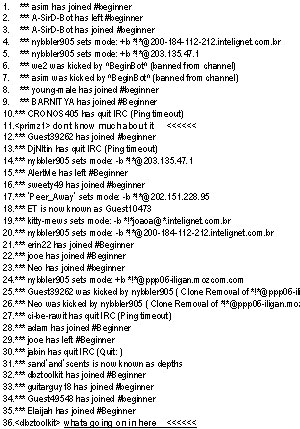
lurking or has logged off. In column B below <Kiera>
makes no utterances between entering and leaving and therefore would be a
lurker. In face-to-face conversation conversational
laps can be equated to a listening phase of conversations. In none of the
chatrooms that I have used in the case studies were there times or
notifications of when people signed in or signed out as is shown in the examples
below.
|
B. http://se.unisa.edu.au/september11/new_york_city_chat_chat.htm
|
|
|
( |
8. 14:57:20
||||||||| Kiera
just entered this channel |
|
( |
9. 14:57:43
||||||||| novyk
just entered this channel |
|
( |
10. 14:57:35
Sascha: no
from |
|
( |
11. 14:57:50
oscar: ok
hello! |
|
( |
12. 14:57:56
MissMaca:
is anyone from NY? |
|
( |
13. 14:58:01
||||||||| dolly just entered this
channel |
|
( |
14. 14:58:04
||||||||| Will just entered this
channel |
|
( |
15. |
|
( |
16. 14:58:09
damaged: im
a fread what will happen next |
|
( |
17. 14:58:14
mike: that was an organized terror
act. what do you people think. |
|
|
18. 14:58:14
Sascha: i watch it in tv it is unbelieveble |
|
19. 14:58:15
novyk:
what's happened there ??? |
|
|
20. 14:58:17
||||||||| Kiera
just logged off. |
In chatrooms
that record every instance of keyboard usage from entry to leaving, changing
names and using pre-set text there can be difficulty in
following conversation (see the example in Case Study 6 ‘6.3’ where there were only two utterances in thirty-six turns[7]). In Case Study 2 where I have
introduced CMC as the technology to investigate non-face-to-face communication
I use an Instant Messenger chatroom that had two
people, and found just as many threads happening as there would be with
multiple speakers. In the two samples that I ‘captured’
I have found several differences in the communicative responses between various Internet communicational devices. In discussion groups and emails people observably take more time and care with what they write. And therefore are not as casual as Instant Messenger (IM) or chatroom conversation. Users of discussion groups and email may use a spell/grammar check, and think before posting their text. There is a more textual format with discussion groups. Instant Messenger and chatrooms appear at first sight to be less disciplined and more varied, with the relative spontaneity of casual interchange unsettling many more formal communicative conventions. In the example below the message from the Hurricane Floyd Messages Board is more developed textual than the chatroom utterance.
|
Hurricane
Floyd Messages board |
|
By
<wpapas> |
Significant
safety concerns for family, friends, and property on Sincerely. Wp |
|
Floyd
chatroom |
|
<ankash> |
Tornadoes
in Pender Count |
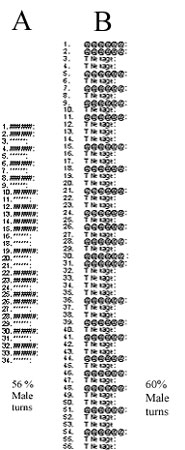
In an Instant Messenger chatroom the readerly writer is
noticeably silent when not writing. In both cases below there are repeated
entries by the same chatter before the other chatter ‘speaks’. In the example
below in case “A’ the male speaker <######:> makes another entry before there is an answer
giving five multi-utterances and seven single utterances. Between the female’s turn at 11 and the her
next turn at 16 there are four male utterances. What this shows in at least
these two chat examples is that the male in both examples outnumber the utterances
of the female. (See Tannen, 1990; Morgan,
2000, on conversational maintenance by men and
women in computer and face-to-face discussions). In the illustration
below in A the male is marked by the symbol ######: and in B the male is
marked by T Neuage. In A there are two instances
of the female pushing the ‘enter’ key (the male has five multiple entries) and
in B there is also only two times in the conversation that the female pressed
the entrance key (the male has eleven multiple entries).
In this one example it is evident that the
males are initiating threads and the female is maintaining them. For example
below, the male has initiated the thread on past lives and the female has
commented on it.
|
1. ######: WE WERE TOGETHER IN THE HAREMS OF
CHINAS THRONE, THE GOOD OLDL DAYS |
|
2. ######: MINE |
|
3. ******: ah...one of those past life miracles |
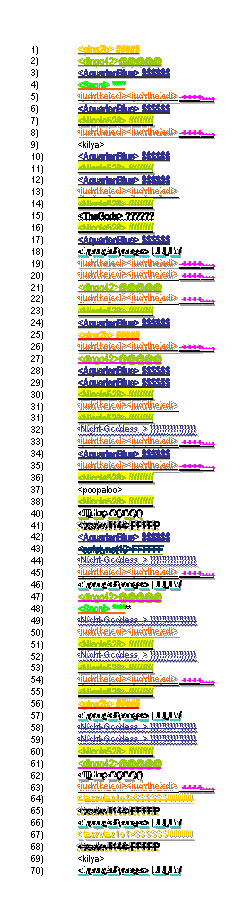
In Case Study 4 the speakers who dominate the conversation
by contrast are female usernames[8];
<Nicole528> has taken 24 turns and <judythejedi>
has taken 22 turns in this part of the chatroom
dialogue. Below <judythejedi> is marked as  and <Nicole528> is marked as
  . I have marked
them so they can be easily seen as the dominating influence in this chatroom[9].
. I have marked
them so they can be easily seen as the dominating influence in this chatroom[9].
I approached this case study with two questions related to Computer-mediated communication.
Do computers change conversation? and are Instant Messenger chatrooms closer to offline-person-to-person conversation than dialogue in a multivoiced chatroom? Firstly computers do change conversation due to the capacity for anonymous communication in a chatroom environment. Without cues available in other forms of communication (voice, sight, handwriting) online writing is a pure exchange of text without any judgment that could be made from a physical contact. How we talk in chatrooms is not the same way we talk in person or in letters or emails. The acceptance of a few words at a time or pictures such as emoticons and icons or the use of abbreviations replaces more elaborate textual or vocal presentations. Meaning has to be written read and understood with a minimal amount of writing. Using chatrooms we are able to form larger communities with people we have never met and most likely never will. Computer-based communication shows evidence of being a continuation of the trend towards universalism in social interaction.
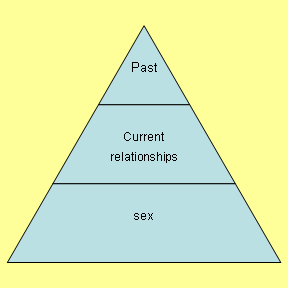
Secondly, in comparison with the chat in Case Study 1 with five threads branching out from the primary topic of the storm this Instant Messenger conversation also had three threads. The overall topic is the two people in conversation as they know one another (as they have informed me that they do). The threads in this ‘talk’ are about past lives, current relationships and talk about sex. The new threads were each initiated by the male speaker.
- past
lives - <######:> <WE WERE TOGETHER IN THE HAREMS OF
CHINAS THRONE, THE GOOD OLDL DAYS>
- current relationship <######:> <YES, I GET TO CALL HER IN ABOUT 2 HOURS
- sex talk <######:> <THE WOMAN HAS FOUR ORGASIMS, A LEAST ONE VERY BIG TWO MEDIUM AND ONE OR MORE SMALL THE MAN HAS ONE BIG AND MAYBE A FEW SMALL ONES>
The conversations begin with speaking about past lives then branches into a current relationship (the male’s current relationship) and goes into the male initiated topic of sex and the conversation ends there.
Instant Messenger or two-only chats are more intimate than multichats. In a public multichat room where it is not known who is present utterances are viewable by all who are present. In the maze of scrolling texts threads of an individual can be found and lost by both the reader and the writer. In IM there is only the two viewers who chooses to respond or not to respond. Instant Messenger is similar to face-to-face conversation in that responses must be made if there is to be a conversation whilst in a mulitperson chatroom if there is no response by one person then someone else may respond to carry a thread forward. As I have shown in Case Study 2 and in the other case studies, multivoiced text-based chat confuses discourse to the point that not only is dialogue difficult to follow but it is difficult to know who is dialoguing. One-to-one online discourse is personal, uninterrupted and closer to ‘normal’ offline conversation.
With this case study I asked whether computers change
conversation. What is changed is how we do conversation – the waiting for a
response, dependent on the person who we are communicating with and the speed
they type and the speed of their computer connection. Another factor in the
speed of turn-talking and understanding what is being said is dependent on the
number of people in the chatroom. The more voices
there are to sort through to carry on a personal conversation can prevent a one
on one conversation from developing. If there are more than 40 people in the
same chat all typing and entering text at the same time – there can be a lapse
between what we write and its appearance in the order of chat. For example in
the chat below that occurred during the World Trade Centre collapses there were
sixteen entrances with eleven particpants in the
minute between 3.07 PM and 3.08 PM. Turn
123 and 124 are both recorded at
|
|
|
|||||||||
sascha just entered this channel |
|
|
|
1Bone!!:
Ich bin deutsch |
|
|
|
Spain_17:
Here in |
|
|
|
novyk: yo
alucino, what's happened in |
|
|
|
damaged:
morons, there weher 2 attacks again, one in pittburg |
|
|
|
Hello:
news: may be Osmat behind this attack |
|
|
|
mike:
where are you from, damaged? because you d'like to
escape to mars. |
|
|
|
Spain_17:
Anybody from the N.Y?? |
|
|
|
oscar: yo
de menorca! que pasada no? |
|
|
|
1Bone!!:
koischer chat hier |
|
|
|
Hello:
I just heard from news |
|
|
|
oscar: que
pasada no? |
|
|
|
captain_insaneo:
in |
|
|
|
Spain_17:
Oscar? |
|
|
|
MissMaca: what's
happened in |
|
|
|
|||||||||
tach just entered this channel |
Not only is it difficult to follow conversation at this pace but one has to quickly respond to a very specific utterance in order to be read and responded to. The speed that communication occurs at with computers and the inability to always access the source of the information and the context that it is in presents the biggest problem of finding meaning in transcripts as it occurs in multiperson text-based chatrooms. In Instant Messenger or any two-person only chatroom there is more chance for turn-taking communication and therefore having a meaningful exchange than in a multi-person chatroom.
CS 3
In Case Study 3 I used semiotic and pragmatic analysis for my tools of investigation of online chat. Firstly, I used semiotics or the study of signs to investigate how conversation was accomplished in a chatroom. I particularly wanted to uncover not just how ‘talk’ is accomplished in a chatroom, but how far chatroom “talk” generally may be said to include a broader than usual repertoire of representation. Mihai Nadin claims that the computer is a semiotic machine as it is a machine that can be programmed to manipulate symbols. Using computers as semiotics has an aesthetic appeal because semiotics changes over time and provides new meanings to old ideas.
In this case study I explore how
the use of non-word representation: emoticons and abbreviations as well as the
“identity” sign-tag or the username of the chatter influenced the turn-takings
of the chat-talk. (see, Crystal 2001; Rivera 2002).
I chose a chatroom named after a celebrity to firstly discover whether usernames, their “identity” sign-tag, would be reflective of the title of the chatroom. In this case study with the title of ‘Britney Spears Chat’ a chatter did have the name of <baby_britney1>. This identification with the chat-title is consistent with what I have found in the other chatrooms in this thesis, such as in Case Study 1, Hurricane Floyd there was the username <IMFLOYD> in Case Study 4 a participants used the names ‘astrochat’, <AquarianBlue>, <TheGods> and <Night-Goddess_>; Case Study 6 ‘web 3d animation’ there was <web3dADM> and < Web3DCEO)> and in Case Study 7, ‘baseball chat’ <MLB-LADY> (major league baseball). Therefore it is evident that usernames can be associated with the name of the chatroom. When the dialogue is read from these specific usernames it is clear that the chatter is interested in the topic of the chatroom such as <AquarianBlue> in Case Study 4;
|
10).
<AquarianBlue> Nicole 528 is gemini |
<web3dADM> in Case Study 6;
|
10)
<web3dADM> just got the Cult3D folks to agree to show up on March 3 |
<MLBLADY> in Case Study 7;
|
6.
<MLBLADY> no clev fan but like wright |
<IMFLOYD> in Case Study 1;
|
220
<IMFLOYD> a swamp that is getting deeper by the minute.............. |
and <Spain_17>: in the Postscript – 911 Chat;
|
120.
<Spain_17>: Here in |
In face-to-face conversation people use an entire array of semiotics:
speech, gestures, facial - but with CMC communication semiotics is restricted
to lines of text on a screen as expression (Stone, 1995a, 93) as well as
usernames, emoticons, colour and sound. Semiotic
analysis thus enables this study to move beyond a linguistic base into
examination of the graphical and expressive modes used to compensate, and maybe
beyond that, to create meaning in new ways, within the new “conversational”
spaces of the chatroom - and particularly so in a chatroom of saturating expressiveness within identity work,
as is the case with Britney chat. In Case Study 3 to fully explore this drive
to identity performance and exploration, to extend the actual communicative
range of the “language” or coding system used, it was first necessary to
examine which communicative functions are actually in use in the Britney Spears
chatroom, and to reveal which are dominant and
recurrent. Firstly what was evident and recurrent in this chatroom
is that chatters employed usernames as signs to give others clues about their
identify. In person-to-person conversation the clues that are given as aspects
of identity are personal identity such as ones social identity which can be
ones employment or educational status - which I compare to the using of unsernames in chatrooms. In this case study the following
usernames were being used when I was observing the chat: <Mickey_P_IsMine>,
<JeRz-BaByGurL>, <Pretty_Jennifer>, <baby_britney1>, <IM_2_MUCH_4U>, <AnGeL_GlRL>, <Luvable_gurl15>, <buttercup20031> and <guest-hotgirlz>.
These usernames suggest that the chatter, if not a young girl, at least
identified with a young’s name. In real-life <Luvable_gurl15> could
be a 58 year old male
Secondly, the title of the chatroom identified
the chatters as interested in the topic of the person, Britney Spears. The chatroom title can provide information on the identity of
the individual such as being in a chatroom such such as ‘Iraq4u’. In this case study the ‘talk’ was
I would predict that the utterances in an adolescent chatroom would consist of only a few words and there would not be an in depth discussion of anything more than ones personal self. As I show in the comparison table with a computer software discussion chat below this is the case. I also found in this chatroom that abbreviations were used more excessively than in chatrooms that may attract an older participation, such as the ‘storm’ chat in Case Study 1. Emoticons serve a purpose more than to save time they are also a type of slang and they show who is in familiar or ‘up-to-date’ with the latest language being used. Of the seven case studies I have found the highest incidence of abbreviations (30%) and emoticons (6%) in the Britney Spears chatroom (see http://se.unisa.edu.au/tables.htm for a statistical comparison of the seven chatrooms). In fact the abbreviation for laughing-out-loud ‘lol’ was used fifteen times. There were 294 words used with the personal pronoun ‘I’ used the most frequently, (18 times) and ‘lol’ used the next most (15 times). In the sequence shown below ‘lol’ is used nine times in 20 turns which is more frequent than in any other chatroom that I used in this study. Another form of laughing-out-loud ‘LMAO’ (Laughing my ass off) was used five times.
The only thread of a conversation ‘captured’ in the Britney Spears chat sequence shown below was about the wish to see a particular person online whilst in the 3D Chat there was a more developed discussion of computer software:
|
1.
well heather he going to end it i just know it 2.
No Syd damn it meee 3.
No hes not ter 4.
Lol 5.
hmmm mickey 6.
But i think hes got a gf so i dont
miss him that muc but well see what tomrrow bringslol 7.
Ok Jenn lol 8.
Yayay lol! 9.
Lol justin 10.
lol 11.
iz lost 12.
will find ya lol 13.
do any guys wanna chat? 14.
afk 15.
Jenn Am i talking to a
brick wall??? 16.
Sis i want Justin to get here! 17.
need to fix my hair.. 18.
hello 19.
wel I duno Mickey lol I juss think hes hottie so i cant really miss him 20.
lol s
dead=( i am going to cry if i dont see my baby soon |
What
VRML options work within AOL? dunno ahhh an ausse...a
bunch of good vrml folks there I
don't believe AOL supports VRML at all Will
X3D work better there because it's Java-based? which
really sucks...but i'm not completely sure X3D
is not necessarity Java based that is just 1
implementation option I'm
sure there will be stand alone and plugin versions
of X3D viewers so
did len say x3d not finalised
yet? x3d
is not finalized yet...yes true i think the final spec is due by siggraph
time this summer but a lot should happen at the web3d conference too is
a lot of business done there? yeah
quite a bit i suppose....most of the
working groups meet |
Chatroom semiotics shows the level of the participator and whether he or she is in the right communicative arena to continue to be an excepted part of the chat community. Identity in the Britney Spears chatroom is determined by the user name and the textual input of the chatter. In face-to-face conversation forms of identification that are used are personal identity, national identity, occupational identity, corporate identity, gender identity and religious identity. (see Berger, 1998)
Secondly, I use pragmatics as a lens of conversational
analysis in chatrooms (Ayer, 1968; Peirce, 1980) to reveal a socially
embedded reading of chat ‘talk’. Pragmatics helps to focus on how the various
communicative items in chatrooms; emoticons, abbreviations and misspelled words
as well as chat utterance sentence structures (CUSS) are used within an online
linguistic society. Pragmatics in chatrooms starts
from the observation that people use online language to accomplish certain
kinds of acts, broadly known as speech
acts (Speech Act Theory is discussed in Case Study 4 below). Studies by
Simeon J. Yates (1996) have shown that the language used in interactive speech
in chatrooms more resembles spoken than written language
in the interpersonal respect (use of personal pronouns) – for example see Case
Study 3, Britney Spears chat, Table 8 - http://se.unisa.edu.au/phd/chapter5/table_8.htm
which shows that ‘I’ has been used 18 times in the chat, the most used word in
the whole chat.
The writing back to a previous utterance in a synchronous conversational situation in chatrooms leads to a pragmatic re-contextualization of the use of semiotic expression. It is how the signs or computer input is read that gives a participant enough meaning to either continue building onto an utterance as a thread or to begin a new thread. In Case Study three there are several utterances that do not become threads as there is no comment to them. For example neither of the following two have a response;
|
23. <baby_britney1> do any guys wanna
chat? |
|
27. <SluGGiE> need to fix my hair.. |
In these next two turns <Mickey_P_IsMine> has no response but responds to his or her self in turn 64.
|
56. <Mickey_P_IsMine> Ahh i got a retest tomrrow mi failin math lol..and i think science |
|
64. <Mickey_P_IsMine>
which i duno how im failin science |
Responding to abbreviations and emoticons shows understanding amongst those who are chatting. For <Paul665> in turn 44. to ask <Jen> to give details on his or her self <Paul665> must assume that Jen knows the abbreviation ‘asl’.
|
44. <Paul665> Ok Jenn asl |
And <Pretty_Jennifer> responds;
|
51. <Pretty_Jennifer>
15/f/fl u? |
I use semantics, (Korzybski 1954; Chierchia and McConnell-Ginet
1990, 1995) to investigate the ‘meaning’ of a linguistic item, considered as
part of a syntactic system, in terms of how the item, (in this case study an
abbreviation) can relate to something else.
For example the abbreviation ‘lol’ can have
different interpretations such as ‘laughing-out-loud’ (the meaning I would
transcribe to this case study); ‘lots-of-love’[10] ‘learning-on-line’[11];
|
16.<Mickey_P_IsMine> But i think hes got a gf so i dont
miss him that muc but well see what tomrrow bringslol |
|
17. <Mickey_P_IsMine>
Ok Jenn lol |
|
18. <Pretty_Jennifer>
Yayay lol! |
|
19. <Mickey_P_IsMine>
Lol justin |
|
20. <SluGGiE->
lol |
|
21. <AnGeL_GlRL>
iz lost |
|
22. <Pretty_Jennifer>
will find ya lol |
To establish an analysis of dialogue I need to have both semantic representation (content of what the different ‘speakers’ in a chatroom are saying) and pragmatic information, the kinds of speech acts chatters are performing, such as; are they asking a question, answering a question that has just been asked, or just announcing their presence. In Case Study 3 I identified a dialogue system, which identify both semantic and pragmatic information from a semiotics reading. And what I found was that in this particular chatroom conversation was able to be continued in a most casual manner with abbreviations such as ‘lol’ fulfilling a user’s turn.
As
with all the case studies I asked particular question in regards to that chatroom. The first question that was asked in this chatroom was whether a popular person’s name as title of a chatroom creates a difference in dialogue in the chatrooms’
From this chatroom I would conclude it did not as
there was only one mention of Britney Spears, whom the chatroom
was based on during the conversation I observed. However, there would need to
be a study of many celebrity chatrooms before a definite answer could be given.
There are chatevents when a celebrity is present and
the questions are to the person the chatevent is
listed for. In this case study the chatroom was named
after a celebrity but from my short stay in the chatroom
there was no indication that it was an ‘official’ site for Britney Spears chatroom. There are thousands of chatrooms dedicated to
Britney Spears and I have never found more than one person in a room when I
checked except for the one used in this case study. From reviewing several of
these chatrooms that include her name in the URL I would suggest that fans of
Britney Spears do not go to chatrooms with her name specifically in them to
discuss her. (see, http://www.britneyspears.ac/chat.html,
http://www.britney-spears-portal.com,
http://www.sterlins.com/britney-spears/chat.html,
http://www.britneyfans.com/chat.shtml,
http://britney-spears.sterlins.com/,
http://www.brachman.com/more-britney.htm,
http://www.superosity.com/britney/home.htm)
The second question asked in this chatroom
was whether emoticons and abbreviations are used more frequently in a youth
orientated chatroom than in an ‘adult’ chatroom. My findings from this chatroom
were that they were and I show this in 5.1.1 Table 1. This chatroom
had 30 percent of turns with an emoticon or abbreviation used compared to the
next highest room, Case Study 6, which had .06 of turns with an emoticon usage.
The difference was that Case Study 2 was based on a teen pop star and Case
Study 6 was on computer 3D animation and the participants appeared older (many
made some mention of family during the conversation). A Pew Internet Project report
(see http://www.pewinternet.org)
in August 2002 found that about
17 million youth ages 12 through 17 use the Internet. That represents 73% of
those in this age bracket.
Fifty-five percent said they used chatrooms and close to 13 million teenagers 74% of online teens use
instant messaging. In comparison, 44% of online adults
have used IM. A
further finding by the Pew Internet Project found that 24% of teens who have used IMs and email or been to chat
rooms have pretended to be a different person when they were communicating
online. Assuming that the majority of those in this case study are teenagers
would suggest that the chatters are content with short utterances that do not
develop into a conversational thread of more than a few words per turn.
CS 4
In Case Study 4 I used Speech Act Theory to see if there were speech acts in a chatroom. Using Speech Act Theory as a means to identify how one communicates and finds meaning in a chatroom, because of the indeterminacy of the “response” mode in chat, makes speech acts difficult to use as a conversational analysis method in chatrooms. It is difficult too to know how much of the intentional load is carried by para-linguistic elements such as emoticons or abbreviations. Therefore my examples for Speech Acts do not include abbreviations or emoticons.
Direct Speech Acts
|
Speech
Act |
Sentence
|
Function |
Examples
|
|
Assertion |
Declarative. |
conveys information; is true or false |
(Case Study 4) 11) <Nicole528> im a Gemini (Case Study 1) 10) <guest-MoreheadCityNC>
NO she's near 10th & (Case Study 1) 77) <SWMPTHNG> THERE'LL BE PLENTY
OF MEXICAN ROOFERS IN N CAROLINA NEXT WEEK |
|
Question |
Interrogative |
elicits information |
(Case Study 4) 2) dingo42 nicole
wahts your sign ?? (Case Study 4) 17) <AquarianBlue>
your meeting her judy? when? (Case Study 4) 32) <Night-Goddess_> anyone
cool in here? (Case Study - 911) 182) Brazilian report: some one
know any new about the manhattan situation ??? |
|
Orders and Requests |
Imperative |
causes others to behave in certain ways |
(Case Study 5)
47) <scud4> bwitched
stop scrollin in here (Case Study 1) 123) <Zardiw>
smptthing................go back to your SWAMP |
Direct speech acts that use performative verbs to accomplish their ends expands the
three basic types shown above with making statements, requests and commands.
- Statements
(Case Study 1) 37) <EMT-Calvin> well folks im
signing off here
(Case Study 1) 233) <IMFLOYD>
i am dying (in the context of this case study this
does not refer to the writer of the text but to the username – implying that
Hurricane Floyd
- Questions
(Case Study 6) 49) <Brian> r u talking about blaxxun and shout3d implimentations
or something else
- Orders and Requests
(Case Study - 911) 296) <MissMaca> Brazillian Report: Iknow it was a building %&#%head. Give up on the
%&#%ing nuke's ok!!!
Indirect Speech Acts
- (Case Study 1) Turn 74) <guest-Tom> does anyone know where floyd isnow
- (Case
Study 1) Turn 125) <guest-kodiak> does anyone know why UNCC has not closed
- (Case
Study 1) Turn 162) <guest-EZGuest367>
Anyone know if I should worry about daughter in west NC?
- (Case
Study 2) Turn 23) HOW DID YOU KNOW
MAMA MY HAIR IS THINING, BUT ONLY ON THE HEAD HE HE
LOL
- (Case
Study - 911) 370) <
These are still in the form of a question, but it probably
is not an inquiry about what the chatter believes someone else will know. Most
of the time, the answer "yes, I do" would be an uncooperative
response. The normal answer we would expect in real life would be "Yes,
Hurricane Floyd is passing over North Carolina now", “UNCC is closed
because of the storm”, “if your daughter is in the eye of the storm you should
be worried”, “I know your hair is thinning because I saw your picture online”,
“another active New York chatroom is at…”. However, only example number 4 is to one
particular chatter, the other turns are to anyone in the chatroom.
Here the reply is directed to the speech act meaning, not the literal meaning.
A simple "yes" answer that responds to the literal meaning would
usually be taken for an uncooperative answer in actual social life (for example
"Yes, I do") would be heard as "Yes, I do, but I'm not
necessarily going to tell you where the storm is, why UNCC is closed or I know
of other active chatrooms in NY". So the five
examples above functions as an indirect question.
The question I sought to answer in this chatroom
is;
“What is a successful speech act in a chatroom?”
Austin and Searle claim that the speech act is the basic
unit of meaning and force, or the most basic linguistic entity with both a constative and a performative
dimension. They both accept that there are illocutionary acts and perlocutionary acts. use Speech Act theory as their
theoretical foundation and analyze the data by message length, distribution,
message links, and interaction. Speech Act theory is a theory based on the
notion that what people say is consistent with what they do.
(Howell-Richardson; Mellar, 1996)
It is not determinable whether <hmmmmmmm>
in the utterance below is a truth statement or a representative of something
else or an answer to the previous utterance of <Night-Goddess_> for this
reason I do not find Speech Act Theory a useful theory to investigate all
utterances in a chatroom.
|
34) <AquarianBlue> hmmmmmmm |
In this chatroom I also looked at what is common
to all chatrooms and that is threads of conversation.
Unlike face-to-face conversation where a person responds to the recent
statement in a conversation in a chatroom an
utterance can be as a continuation of someone else’s utterance or it can be on
a new topic with the hope that someone else may join in. For example below
shows three unrelated utterances but all are either continuation of a thread or
the initiation of a new thread;
|
30) <judythejedi> i don't think so..she's bringing amtrack down maybe |
|
31) <Nicole528> whats your sign dingo? |
|
32) <Night-Goddess_> anyone cool in here? |
Following <Night-Goddess_>’s utterance <anyone cool in here?> a thread develops that discusses the issue about whether anyone is ‘cool’ in this room.
|
32)
<Night-Goddess_> anyone
cool in here? |
|
33) <judythejedi> hi night |
|
34) /\32 <AquarianBlue>
hmmmmmmm |
|
35) /\32 <judythejedi>everyone
is cool here |
|
36) /\32 <Nicole528> is cool lol |
|
37) <poopaloo> 10ty judy |
|
38) /\32 <Nicole528> is cold too |
|
39) <sara4u>
I LOVE YOU TO MUCH.......ACARD |
|
40) <jijirika>is back |
|
41) /\32 <tazdevil144>
cool |
For this speech act to be completed there needs to be an
understanding of what <Night-Goddess_> means by ‘being cool’. She could
have been asking whether anyone was ‘cool’ but to an outsider, one from a
different area of the world or different culture that did not follow the same
linguistic slang used in this chatroom, it could have
meant the participants were in a cold climate. Reading the response does not
clarify the story because everyone could be cool as they are using their
computer whilst sitting in a refrigerator or they may be in
|
49) /\32 10c. <Night-Goddess_>
I is not cool |
|
50) /\49 5l. <judythejedi> yup |
|
51) /\49 6j. <Nicole528>
really |
|
52) /\49 10d. <Night-Goddess_>
I is awsome |
|
53) /\49 6k. <Nicole528>
yes your cool |
|
54) /\46 5m. <judythejedi> lol..i know prncess |
|
55) /\47 6l. <Nicole528>
cool dingo |
|
56) /\52 1c. <gina2b>
coolfool |
|
60) /\47 <Nicole528> im
a gemini with tauras moon
and scorpio rising |
|
61) /\55 <dingo42>not cool...just me |
I also noted the presence of Speech
Act Disruptions (SAD) in chatrooms
beginning in this chatroom. SADs
are disruptions that are particular to chatrooms. On
many chatsites these are the advertisements from the chatroom provider. After every so many lines of text, which
differs from server to server, there will be an ad to purchase something
available from the server. This disrupts the conversational flow at the time.
However, from observing this in hundreds of chatrooms
I have never seen anyone refer to the advertisement, instead, participants
continue what they were discussing or begin a new topic or thread of
conversation. Disruptions are an ignored speech act. The speech act is the ad
that says to buy a specific product or go a website to learn more about a
service or product.
CS 5
My purpose in using this particular chat was to examine a chatroom with a markedly short turn-taking series, to discover if even in a passing conversation, there was enough time to establish a communication community amongst the chatters present. Discourse in a text-based chat is fleeting as text disappears as it scrolls by. The participant gets one opportunity to read the text after which time it cannot be retrieved. This I have called ‘fleeting text’. Online fleeting text affects discursive connectiveness. Spoken language is dynamic, fleeting, irreversible speech, but printed language breaks the strictures of time and leads to permanence. The two together in an online environment has elements of both – what has been said can be ‘revisited’ as long as the chatroom is showing previous turn takings. Knowing that what is said is not retrievable (along with the identity of the speaker not being known) gives rise to anything being said with little consequence. In some chatrooms a user can be booted off the chatserver but most Internet chatrooms that do not have a moderator will not have a means to stop someone from saying whatever they wish. Therefore there are not the discursive connections that would be made in face-to-face communication.
Framing is a phenomena in chatrooms, where a topic beginning and ending are marked. In a chatroom these framed pieces of conversation are not necessarily sequential. They twist around, stop and start, and several may occur at one time in a seemingly chaotic fashion. Framing gives a starting and finish point to a thread. The frame can be as simple as asking a question and the resultant discussion of the question as the example thread in regards to being cool.
|
32) <Night-Goddess_> anyone cool in here? |
|
49) <Night-Goddess_> I is not cool <Night-Goddess_> I is not cool |
|
52) <Night-Goddess_> I is awsome |
The framing of the thread will determine the contextual
arrangement of the discussion. If there is hostility or as shown in Case Study
1, racism, (toward Mexican roofers) the speakers will contribute to the thread
in like manner – for example they will support the original statement. Above, <Night-Goddess_>
frames the thread, and there are other threads within this sequence, with turn
32 and turn 52. A different speaker can end the thread giving a multi-chatter
frame. (see Tannen, 1998; Bays 2000). Without
framing a thread can continue indefinitely. Framing is what completes the
thought in chatroom discourse.
In this chatroom I asked in particular, ‘Does a chatter have a discourse intent when he or she enters a chatroom?’ The term chatter would identify a person as one who has become involved in chatroom conversation. Not everyone who is in a chatroom is a chatter. There are those who visit a chatroom and lurk – make no utterances. In chatrooms that list those present in a panel on the chatsite it is obvious when someone has not participated. However, none of the Internet chatsites that I used for this thesis showed who was online. In Case Study 5 I showed who contributed to the chat conversation and the amount of times they gave utterances. Whether there were another dozen people online at the time this does not show – for example I did not participate in chat and therefore was a lurker, therefore my name does not appear on the list below.
Number of turns taken in this segment
1. tab_002 9
2. Leesa39 12
3. jenniferv 8
4. Ashamo416 1
5. B_witched_2002-guest 37 ALL SAME - - ‘OHI’
6. scud4 5
7. MtnBiker99 3
8. SiReNz_A 1
9. Hooligan3 1
10. soldier_boyedo835 7
11. MCXRAY 2
A person in a chatroom therefore does not display discourse intent until an utterance is given.
CS 6
Using Conversation Analysis (CA) theory in chatrooms seems like a natural way to discover how people
communicated online. While the ‘capturing’ of data is different in chatrooms than in face-to-face discourse there are
similarities in what is done in analysis. Traditional CA researchers tape
record a session and they discuss from a printed readout what happened in the
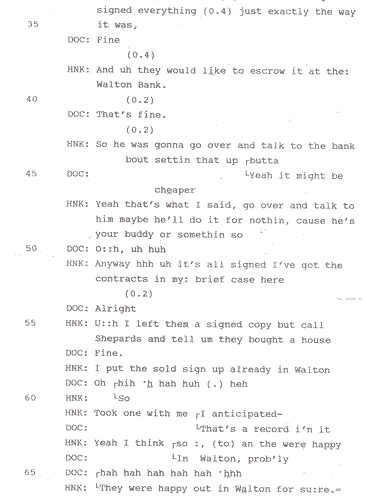
conversation. In the example below from a taped session[15] the
time between turns and pauses in the conversation are noted. In CA most work is
done with two or three people speaking. In the example below there were two people
having a phone conversation. Conversational analysis of chatroom
talk shows adjacency pairs and turn-taking common to the techniques of CA and
the primary difference as this case study and others have shown is the
interjection of conversation before a thought is complete, due to the enter
button and the long periods between utterances that are filled with other
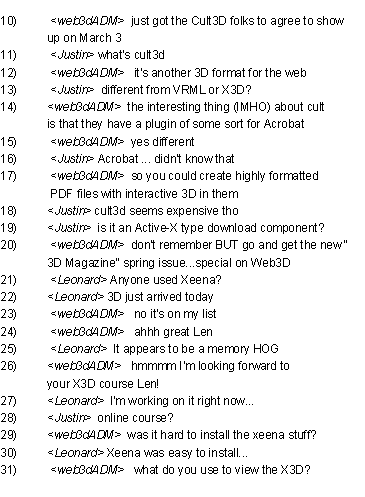
streams of talk. In example A and B below we see turn-taking and the
development of a conversation. In A there are interruptions (for example in
turn 45) which is impossible in chatroom turn-taking.
Utterances are complete in chatrooms with the only
breakage in a particular utterance being made by the user at the time of the
utterance – they can press the enter button and the utterance becomes broken.
In turns 21-24 below (column B) <Leonard>
makes two utterances that are
different thoughts but because they are entered sequentially without anyone
making an utterance between the two thoughts <web3dADM> is left to answer them
both as different thoughts sequentially after <Leonard>’s entrances.
21) <Leonard> Anyone used Xeena?
22) <Leonard> 3D just arrived
NEW SITE = JULY 2014 - http://neuage.us/2014/July/ - Today
23) <web3dADM> no it's on my list
24) <web3dADM> ahhh great Len
In a face-to-face conversation one would assume that <web3dADM> would
respond to <Leonard> saying
<Anyone used Xeena?> with the utterance <no it's on my list>
and to <Leonard>’s <3D just arrived NEW SITE = JULY 2014 - http://neuage.us/2014/July/ - Today> with <ahhh great Len> making the conversation being:
21) <Leonard> Anyone used Xeena?
22) <web3dADM> no it's on my
list
23) <Leonard> 3D just arrived
NEW SITE = JULY 2014 - http://neuage.us/2014/July/ - Today
24) <web3dADM> ahhh great Len
In fact <web3dADM>
could have been typing in <no it's on my list> at the same time as <Leonard>
was typing in <3D just arrived NEW SITE = JULY 2014 - http://neuage.us/2014/July/ - Today>. This is the unusual nature of
online chat that a user can be responding to an utterance at the same time as
someone is typing in another line.[16]
|
A CA transcription from tape recording |
B Web 3D Chat http://se.unisa.edu.au/a6.html |
|
|
|
According to conversation analysis, turn-taking is integral to the formation of any interpersonal exchange. Unless one is lurking the participants in chatrooms demonstrate their knowledge of the chatsite they are visiting in order to be accepted or rejected by others in the chatroom. The signaling of one’s status as an insider or not is important to establish dominance. In the chatroom I used for this case study the topic was on computer animation and it is clear that <web3dADM> is the leader or moderator in this case study, not only because of the abbreviation for administrator (ADM) behind the <web3d> part of the username but because <web3dADM> provides answers to questions people ask in the chatroom regarding the chatroom itself.
The underpinnings of CA, sequential organization,
turn-taking and repair, and how they can depict interactional
competence is useful in reading chatroom talk. Unlike
face-to-face conversation the sequential organization needs to be separated
from what else is being done in the chatroom. The
isolating of pairs in the chat is difficult if there are many people chatting
and the text is scrolling at a rapid rate. In finding adjacent pairs in Case Study 1 the
conversation had to be isolated. What is shown is that there is a turn-taking
strategy present between <lookout4110>
and <Werblessed>
but each utterance had several turns in between.
|
Turn |
Between Utterances |
Speaker |
utterance |
|
|
|
|||||
|
60. |
|
<lookout4110> |
Who is in Wilm. right
now? |
|
|
64. |
4 |
<Werblessed> |
Im 50 Miles west of Wilm. |
|
|
|
|||||
|
73. |
9/13 |
<lookout4110> |
How ya holding up Werblessed? |
|
|
83. |
10/19 |
<Werblessed> |
So far just strong wind gusts and lots of rain..
Over 8 inches so far.. |
|
|
|
|||||
|
89. |
6/16 |
<lookout4110> |
Have the winds been strong? |
|
|
98. |
9/15 |
<Werblessed> |
Gusts up to 60-65 so far its starting to pick up a
bit.. Only gonna get stronger Between now and midnite |
|
The first number in the ‘between utterances’ column is the
number of turns since the previous utterance was addressed and the second
number is the number of turns since the last utterance by the same speaker. After these three sets of turn-takings <lookout4110> and <Werblessed> no
longer had direct interaction. <lookout4110> made more utterances with
the final one being turn 164 and <Werblessed>’s final utterance in this segment was at
turn 180.
CA considers repair as part of normal conversation;
“When we consider spontaneous speech
(particularly conversation) any clear and obvious division into intonational-groups is not so apparent because of the
broken nature of much spontaneous speech, including as it does hesitation,
repetitions, false starts, incomplete sentences, and sentences involving a
grammatical caesura in their middle” [Cruttenden,
1986, pg. 36].
In chatrooms repairs come about due to two primary causes. The first is shown in column A below and the second in column B. The first is because a word was typed incorrectly - <IroquoisPrncess> says <hey Judy did a get my car inthe link thingy> and ‘car’ is a proper word but <judythejedi> does not associate the word with the utterance leaving <IroquoisPrncess> to correct the error. The second error is due to pressing the enter key and dividing one’s utterance because another person has taken a turn between the repair can be carried out.
|
From Case Study 4 http://se.unisa.edu.au/a4.html |
From Case Study 6 http://se.unisa.edu.au/a6.html |
|
57)
<IroquoisPrncess> hey Judy did a get my car inthe link thingy 63)
<judythejedi> car in the link? 66) <IroquoisPrncess> card |
40) <Leonard>
I will be offereing it on-line through 41) <brian> can't make
it 42) <Leonard> spring |
I found from this case study and
the use of conversational analysis that the techniques used in the processes of
reading conversation can be used in chatroom analysis
also.
CS 7
In this chatroom on baseball all the linguistic approaches of grammar looked at do not explain the question asked at the start of this case study; What is the function of grammar in chatroom language?
Language in a chatroom is altered both deliberately and by mistake. Miss spellings and changes to language on the Internet may not be deliberate. Typing can lead to accidental changes in spelling and punctuation. On the other hand the grammar of chatrooms, if it is done intentionally is a highly sophisticated form of prose that is semantically innovative and daring.
Below, <CathyTrix-guest> in
turn 108 says <2blech> which has no conventional linguistic place but in
this chatroom it is appropriate grammar as the ‘2’
refers to an earlier request for chatters to press the ‘1’ (3)? key if they
liked the New York Yankees. <CathyTrix-guest>
emphases his or her dislike of the Yankees by pressing a different key than ‘1’
and confirming it with a ‘blech’ which is not a word
but has the same letters as ‘belch’ and most likely would be interpreted as
‘belch’ which is a fairly conventional vomiting representation. In that turn
there is both deliberate and mistaken altered language. In turn 77
<MLB-LADY> asks if ‘dd any see the atanta score’ with two spelling errors. Assuming the
correct wording is, ‘did any see the
As well as leaving out letters single digits are used in place of whole words u – you, 4 – for, r –are, c – see, 2 - to and in 128 below <BLUERHINO11> refers to <dhch96>by using the letter d.
In chatrooms, grammar is a developing protocol. Common practice theories of grammar are applied differently in chatrooms. In society, we use the use to grammar to judge people in terms of social status and education. In chatrooms the rules have changed. A person may be judged by how efficiently he or she types, deliberately miss-spelling words by leaving out vowels as I have demonstrated. Unlike in face-to face conversation, one does not seek to impress others in chatrooms by the correct use of both spelling and grammar.
5.1Case Study Wrap-up
Electronic hat is not only one small communication
exercise among many, but an important part of everyday life. Internet text-based chat is changing with the
increasing use of webcams, multimedia and 3D
Graphics-based chat communities[17] and the
ability to use voice instead of only text. New applications of text-based chat
are appearing with the availability of wearable computers[18], including miniature PCs, personal digital
assistants (PDA), cellular phone watches, cognitive-radios[19], and
electronic performance support systems (EPSS)[20]. Such devices will enable people to access
information via networks anytime, even while out walking. What my study has
shown is that electronic chatrooms shows a current
pressure in communications and though it is technology based it is indicative
of other life and work pressures. More interesting is the creativity displayed
in overcoming the pressure: use of graphics, emoticons and abbreviations as in
themselves communicative elements.
5.1.1 Features of chatrooms
This study has shown that chatrooms have limitations that conversations in which physical speech is produced do not have. A list of findings identified in the case studies and discussed above are below and they show what is unique about chatrooms:
Features
of Chatroom (emphasised in
Case Study 1-7)
- Author
as reader, reader as author (Case Study 1)
- Misleading
titles (Case Study 1)
- Multiple-Authorship
in different chatrooms (Case Study 2)
- Avatars
(Case Study 3)
- Emoticons
(Case Study 3)
- Threads
and Discontinuity (Case Study 4)
- Discontinuity,
i.e. popup ads or ads amongst the turn-takings (Case Study 4)
- Chatroom graffiti (Case Study 5)
- Fleeting
text (Case Study 5)
- Lurking
(Case Study 6)
- Collaborated-Selves
(Case Study 6)
- Spelling,
Abbreviations and Grammatical errors (Case Study 7)
- Long
gaps between asking and answering in turn takings with other turn-takings
in between
- Metaphysical-chat-linguistics;
anticipating discourse
- Repeated
utterances with little or no content i.e
‘hello’, ‘anyone want to chat’ (Case Study 1)
- Keyboard
writing not showing emotions of hand-written correspondence
What I did not discuss in a particular chatroom
is that talk in chatroom is limited to short phrases.
Rarely will there be more than several words written at a time by a 'speaker'. Counting
the words of hundreds of entrances in my seven chatrooms
(see table below) and the postscript I found that there was an average of 5.82
units per turn; this includes words, abbreviations, emoticons. Within that
sampling 25 percent of words consisted of two letters, and 20 percent consisted
of three letter words. Using CMC or the computer as the tool for electronic
discourse analysis, introduced in Case Study 2 I computed that eighty-three
percent of words used in chatroom conversations were
five letters or less.
In the seven case studies I have used several analytical
theories to examine chatroom talk. I highlighted
certain chatroom features of online discourse in each
case study. These features are common to all chatrooms
but in using the data from particular chatrooms I
isolated the primary components of an online discourse.
|
Case Study and Data location online |
Theory |
Methodological focus |
Authors referenced |
Chatroom
Features |
# of users |
Turns
recorded |
# words[21][1] |
|
||
|
Case Study 1 Data Location |
Response Theory |
Web
of authorship, readership & subjectivity |
Iser |
o
2-readings:
title of chatroom & text. o
Reading
as fact. o
Author-Reader
same |
45 |
279 |
2001 Avg.
7.17/per turn |
|
||
|
Case Study 2 Data Location |
CMC |
Introduces
the technology into the communicative act, and reveals the multi-layeredness of the chat |
|
o
Real
time conversation to many people in different locals. o
Talk
in more than one chatsites at one time. |
2 |
34 |
385 Avg. 11.32/per
turn |
|
||
|
Case Study 3 Data Location |
Semiotic
Analysis |
Introduces
a socially-embedded reading of communication still regarded as symbolic
activity. |
Halliday Levinson
Robert
Nofsinger |
o
Emoticons,
virtual chats[22][1], avatars
(author as sign/symbol) o
Celebrities
as titles of chatrooms |
17 |
70 |
294 Avg. 4.2per
turn |
|
||
|
Case Study 4 Data Location |
Speech
Act |
What
a 'speech act' is when it is conducted in written: an altogether different
coding. |
John
Austin John
Searle |
o
Disruption:
Timed interruption from server’s ads. o
Threads
and discontinuity o
Speech
as home. Chatrooms as created place |
16 |
85 |
297 Avg. 3.5//per
turn |
|
||
|
Case Study 5 Data Location |
Discourse
Analysis |
Symbolic
(language) and the (embodied) social/cultural, as linked within practice. |
Norman
Fairclough Deborah
Tannen M.
Stubbs |
o
Fleeting
text o
Chatroom graffiti |
11 |
89 |
285 Avg. 3.2/per
turn |
|
||
|
Case Study 6 Data Location |
CA |
Focuses
right in onto the details of communicative exchanges |
Sacks,
Jefferson, Schegloff Nofsinger Erving Goffman Slade
& Eggins |
o
Lurking
o
Collaborated-Selves
as The Author |
8 |
511 |
2248 Avg. 4.4/per
turn |
|||
|
Case Study 7 Data Location |
(linguistic
schools) |
|
|
o
Abbreviation,
spelling and grammar errors. |
13 |
151 |
1011 Avg. 6.7 /per turn |
|||
|
|
||||||||||
|
Postscript http://se.unisa.edu.au/postscript.htm Data Location |
||||||||||
As this study looked at the linguistic of online chat it did not try and reveal how the users felt about their time online. Studies have been done that show that a majority of chatters; ‘felt like they could jump right in and chat’, ‘chat discussions are too superficial’, ‘chat went too fast because he or she could not keep up with the conversation’, ‘14 out of 15 felt a moderator was needed’. [23] My research has not identified what people think but the fact that users can jump in and chat differs from face-to-face conversation in that there is no overlapping or butting in when an utterance is sent to a chatserver; chat can go too fast if there are many people on at one time such as in the ‘911’ chat discussed in the postscript chapter when there were dozens of utterances entered into the chatroom per minute; without a moderator chat can be hectic and any topic can be changed to create new threads – when there was a moderator as in Case Study 6 – the topic stayed focused, I discuss moderated chatrooms more in the postscript when I compare a moderated chat about the events of September 11th with an unmoderated chat.
Chatrooms provide one of the most
universal forms of communicating. By late 2002 there were 4206 internet cafes
in 140 countries[24]
and wherever there is an internet café there is the opportunity to chat online.
In the middle east there were the follow chatrooms
available and most had translating software for the language of the chatters to
be translated into the user’s native language. On the chatserver,
http://www.chatinternational.com
there were the following numbers of chatrooms
currently available (as of December 2002);
|
|
|
|
One
typical chatroom without the translation software
appears below;
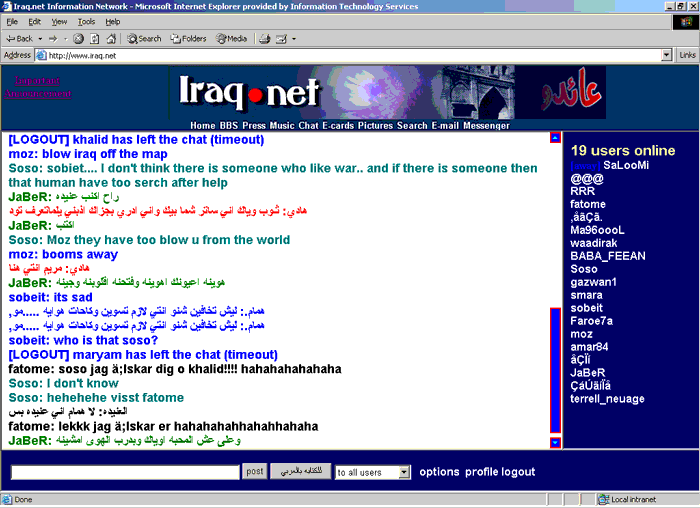
the appearance has some similarities
to the chatrooms I have used in all my case studies except that this is a JavaScript
chatroom and the log could not be captured as text. The other dissimilarities
to the chatrooms I saved is that this type of chatroom shows all the users who are logged on whereas in
the chatrooms I used in this study only when someone
made an utterance did their username appear. In the chatrooms
in my case studies it is easier to lurk without anyone knowing you are there.
In this chatroom there is no time posted for when the
users enter therefore it is impossible to note whether there are pauses between
speakers as I showed above with CA transcripts of oral utterances. In the
twenty-minutes I was in this chatroom[25] there
were three who spoke English and in the ‘captured’ screenshot above <Soso> is responding to (moz>.
Comparing this to a non-western site, a Lebbon chatroom, the speaker in this chat is not demonstrating
good command of English but that <semsem> wants
to speak with someone is clear. It is possible that this chat was translated
into English as the user wrote. Common abbreviations are used that would be
found in any Western chatroom such as <how r u>
and the emoticon < :) > is used.
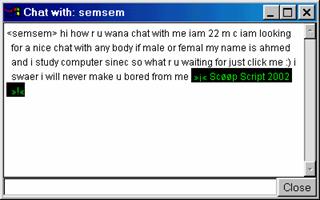
What has not been
discussed in this study as I have only found a few examples is that in the chatrooms that I sampled, titles sometimes had a bearing on
the username, such as in Case Study 1, Hurricane Floyd,<IMFLOYD>;
Case Study 3, ‘Britney Spears Chat’ <baby_britney1>; Case Study 4, ‘astrochat’, <AquarianBlue>,
< TheGods>, <Night-Goddess_>; Case Study
6 <web3dADM>, <gordon (Web3DCEO)> and
Case Study 7, ‘baseball chat’ <MLB-LADY> (major league baseball). Usernames both identify how the user view his
or her self and also his or her place within the particular chat milieu.
Another finding that this study has shown is that online chat communities do take on social agendas as much as they would in person-to-person meetings. Communities of practice can be communities marked by acceptable and non-acceptable behaviours registered at the level of the doubled speech of chat, with its semiotic loadings of meaning and familiarity. In Case Study 1 it was apparent that there was an ease of the speakers to discuss Mexican roofers in the midst of a discussion of a national emergency. In Case Study 7 the baseball chatroom has a community of practice where the participants are comfortable with their talk. In this case study the participants have not developed an in-depth discussion but there are the same practices of greetings as are shown in face-to-face meetings.
By examining discourse in a chatroom one may affect not only their own world-views but also others’. This is accomplished through exchange in an environment that is considered safe by the user. If the environment is not what the user wants then he or she is able to leave and find one that fits their communication aspirations. The freedom of expression in a chatroom is questioned on legal social, philosophical and political grounds
5.2 Research Questions and answers
The asking of these questions throughout this thesis and answering them now as well as the twelve questions asked and answered in the seven individual case studies have helped me with the five assumptions formulated at the beginning of this research.
My approach to examining online chatrooms began with the posing of the following five questions[26] as a starting point toward analyzing a culture of electronic-talk:
5.2.1 Is turn taking negotiated within chatrooms?
On occasion it
is but there is no set protocol or even netiquette outlining turn-taking
negotiations online. There are ‘rules’ of engagement that are common to facilitate
interaction in a chat session. The below list[27] appears
on many chatroom sites with the following suggestions
of how to use chatrooms most effectively.
- Latecomers
to the session should scan the previous 10 -20 posts to get oriented
before submitting a post.
- Upon
entering the chat session, greet everyone and announce yourself.
- If
you do not wish to contribute to the discussion, you should still make
your presence known by announcing that you are lurking. This is considered
polite, especially if you join in the discussion later.
- Wait
for others to respond to your initial post before joining the discussion.
- Address
individual people you are responding to by name so they know you are
talking to them.
- Do
not post more than three sentences at a time.
- Allow
a few moments for others to read and respond to your message before
posting again. This turn taking strategy will allow the dialog to flow
between you and the others and avoid crossed messages.
- Break
lengthy messages into short segments, each ending with "More…"
then continue the message in the next post.
- Be
as clear and concise as possible - if you think you have been
misinterpreted, reword your message and post it again.
- Ask
for clarification if you do not understand something posted by someone
else.
- Capitalize words only to highlight an
important point, otherwise it is considered SHOUTING and is rude.
- When you are ready to leave the chat
session, announce that you are leaving but stay long enough to respond to
final messages directed to you.
- Say good bye when you are ready to log
off. Your last message should end with an indicator such as "LP"
(last post).
In my findings of seven case studies looking at hundreds of turn taking events I have found that turn taking is negotiated in one way only. By pressing the enter button the response is put into the chatroom. This is true in all unmoderated chatrooms where there is no control to the amount of text one puts in. However, as was shown in moderated text-based chatrooms the ‘talk’ of a chatter is only inserted into the conversation at the discretion of the person moderating the chat. In other words it is a ‘self-controlled’ negotiation to a point. If there are dozens of people entering data into a chatroom about the same time then where one line follows another is a random event and may not be the response one would have put following the prior utterance. For example in the chunk of chat below (from 911 chat), within four seconds four turns were taken and though they were all on the same topic none answered any other and all four may have been in different countries and they could have all pressed the entry button at about the same time. There is also the chatserver that handles the income data, it could have received a dozen entries at one time and they would just have gone in as the server put them in.
|
|
|
< |
|
|
|
<1Bone!!>: please, say ricght |
|
|
|
<MissMaca>:
nuke bomb, i don't thinks so! |
|
|
|
<oscar>: |
My case studies have shown that there is sensitivity and turn negotiation – for instance, the group excluding some players as in Case Study 5 when others in the group did not respond to <B_witched_2002-guest> or in Case Study 1 when some in the chatroom did not want to continue the discussion on Mexican Roofers because of the racist sounds to the utterances some were making.
5.2.2 With the taking away of many identifying cues of
participants (gender, nationality, age etc.) are issues of sexism and political
correctness, as prevalent, as in face-to-face talk?
Yes. In unmoderated chatrooms (e.g. case study 1, 3, 4,5, 7 and two from the 911 events) there seems to be a ‘free for all stream of consciousness’ where anything anyone wants to say is said with little restraint. However as has been shown in these case studies others in the group will respond to someone who is being difficult or not continuing with the immediate discussion.
Other chatters can gang up on a person who is annoying but they are not able to make them leave (online) unless they are the server. People will leave because of how others are reacting though. I showed an example of this in Case Study 5 when [OHI] is repeated 37 times in 89 turns by <B_witched_2002-guest>. People can respond to someone that they feel is not appropriate but the person stays in the chatroom. Not always… In the example in Table 5 the chatter < BoOoOosS!> has kicked <proplem_IN_RAK>
|
*** proplem_IN_RAK (213.42.1) has been kicked by BoOoOosS! ( bad ) |
Table Discussion:1 ArabChat
In the example below in the unmoderated
chat on 911 [fRANKIE] (says),
|
<fRANKIE> gina i s a stupid butch (turn 18) |
Table Discussion:2 gina i s a stupid butch
as a response to his or her (gina is a female name) utterance,
|
<gina> I WANT EVERYONE TO RECOGNIZE US AS A CARING AND INTELLECTUAL PEOPLE LIKE OUR GREAT LEADER AHMAD SHAH MASOOD |
again, in Case Study 1, there is an incident of racism when a discussion begins about Mexican roofers repairing damage caused by Hurricane Floyd,
|
<SWMPTHNG> THERE'LL BE PLENTY OF MEXICAN ROOFERS
IN |
|
<EMT-Calvin> and those folks will be sent
back to |
Table Discussion:4
In a moderated chatroom a person’s statements go through a moderator. The moderator acts as a filter, where the moderator’s ‘rules’ are applied. For example, sexual, or racial content may be ‘moderated’ out. Moderation also occurs in these chatrooms as ‘self’ moderation. People tend to choose their words more carefully in a moderated chatroom; so there are two types of control operating in these chatrooms, self control and control by the moderator. Chatroom control by others in the chatroom is evident in Case Study 1. When <SWMPTHNG> says,
Turn 77. < THERE'LL BE PLENTY OF MEXICAN
ROOFERS IN N CAROLINA NEXT WEEK> and begins
a thread and is firstly challenged with this line of talk by
<guest-MisterD1>
16 turns later but it is <Zardiw> in
turn 125. <smptthing................go back to
your SWAMP> that brings this line of talk to an end with <SWMPTHNG> making one last remark in turn 130 – this could
have been typed before <Zardiw> had
entered his or her turn and <SWMPTHNG> could
have pressed the enter key without reading <Zardiw>’s
comment – whatever the case there is no more mention of Mexican Roofers in this
segement.
|
|
82. <EMT-Calvin> and those folks will be sent back to |
|
85. <EMT-Calvin> the locals will be the
ones to get jobs |
|
88. <playball14> they work hard here
|
|
89. <SWMPTHNG>
WHOSE GONNA SEND THEM - THEY'LL BE CLIMBING ALL OVER EVERY HOUSE ON THE COAST SE HABLO ESPANOL
|
|
91. <guest-MisterD1>
sigh... |
|
96. <EMT-Calvin> folks
need to be careful for con artest after the storm |
|
101.
<KBabe1974> i agree with emt-calvin |
|
102. <guest-MoreheadCityNC> Fortunately our best friend is a
roofer! |
|
103. <playball14> everybody
out for a buck unfortuneately |
|
104. <SWMPTHNG> YOU
AINT TALKING ABOUT MEX ROOFERS ARE YOU? |
|
106.
<KikoV> you mean carpet baggers |
|
114. <SWMPTHNG> i SAW A BUS LOAD HEADING ACROSS THE |
|
125. <Zardiw> smptthing................go back to your SWAMP |
|
130. <SWMPTHNG> WHAT
AABOUT THE CONTRACTORS WHO HIRE THEM?? THEY OUGHT TO BE TRIED FOR TREASON
DURING A NATIONAL EMERGENCY LIKE THIS |
5.2.3 Will chatroom discourse become a universally understood language?
The Word Wide Web provides text-based chat to communicate
with others in Iceland, Azerbaijan, Senegal, East Timor, Madagascar or anyone
of hundreds of countries[28]
with live broadcast feeds from every country in the world and text-based
chatrooms to ‘speak’ with others. Many text-based
sites offer instant translation, meaning that one writes in their native
language and it is translated into the language of the chatroom.
On
As I have shown in my research, some emoticons are common to a number of languages. Here is an example of a Dutch and a German list. In Case Study 3 I have shown how emoticons represent feelings. In this case study I have cited examples from Dutch, Spanish and Japanese chatrooms and below I show that emoticons have become a universally understood language.
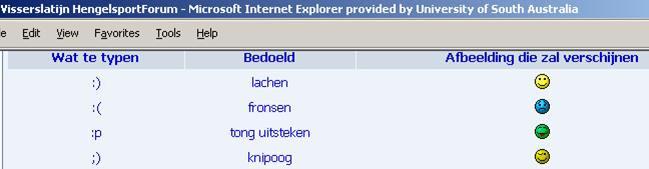
Figure Discussion:1 Dutch emoticons
|
Die Standard-Emoticons: |
|
|
:-) |
lachendes Gesicht, "nicht-alles-so-ernst-nehmen" |
|
:-( |
trauriges Gesicht, "find' ich schade!", unglücklich, ... |
|
;-) |
Augenzwinkern,
"War nicht so ernst gemeint", ... |
|
:-O |
"Oh!",
Erstaunen, Erschrecken,"Aaa"
beim Zahnarzt... |
|
|
|
Table Discussion:5 German emoticons[30]
5.2.3.2 Table 11
|
En attendant je
fais du gros boudin |
 pour pas dire

Table Discussion:6 Spanish emoticons
|
<ÇÞæáå> ããßä ÈäÊ ãä ÇáÞØíÝ Êßáãäí ÇÐÇ ããßä ¿¿ (^_^) |
Table Discussion:7 Arab emoticon
So what is your
point here? Your findings? Your conclusions?
5.2.4 How is electronic chat reflective of current social discourse?
This was one of five questions I asked at the start of this project in early 1998. After five years of research into text-based Internet chat I would suggest the question turned around would be closer to how communication is changing. In other words I would ask whether current social discourse is reflective of electronic chat? I would suggest that the answer is that electronic chat has become a current social discourse. Yes yes clever – but HOW? Expand… what are the DISCOURSES in e chat that represent major social-cultural trends??
One of the problems with online conversation is
with understanding what is being said when the traditional physical cues
are deleted. Can conversation even exist without knowing anything about the
participants or who the audience is? My research says yes! People are fully able to communicate as long
as there are structures to communicate within. These structures have a
linguistic base, which “stand in” for our categorisation
of speakers and have been further explored in the case studies. OK good – now show the proofs,
and find CONCLUSIONS…
People are communicating with social groups as never before as has been shown by the number of people online worldwide (1.4 Online usage) - which is close to one in six people being connected.
We can only speculate at how online text-based chat will
affect the future way people speak with one another. For example, will people
only ‘speak’ with those people who understand what they are saying in five or
so words? Instead of explaining meaning, will conversation only continue with
those who grasp what is being said immediately? In the rapid pace of chatroom ‘talk’ this seems to be the case. There is also
the danger that people can become poor communicators. Text is ‘spoken’ often to no one in
particular with the apparent hope that someone, somewhere will grasp the
utterance and respond appropriately. Oh come on Terrell: how much online chat do you do daily as compared to
live chat?? Get it in proportion… This is NOT what your research data shows:
this is silly conjecture…. Your data
shows the results of talk when texted under pressure
– that’s all. Major findings? Well – you tell me! But your CONCLUSIONS have to
be based on those findings – for instance, the different ratios of information
talk versus greetings in various sites… Now THERE you CAN draw some
conclusions.
I Your research shows NO CONNECTION WHATSOEVER here. This is silly conjecture and moral panic. Stop it. USE the REAL FINDINGS. n chatrooms the world over there are similarities of text-based chat, whether it is the few words or just letters as I have discussed in the case studies or in a foreign (foreign to me as an English speaking person) there are letters and numbers used as complete thoughts. A comparison is made below with chat from Case Study 7, a baseball chatroom and a Chinese chat; the chat in the left column is numbers, the chat on the right uses letters, and except for <wu~yuan~you> in the last line who says hehehe after a series of words in Pinyin there are no words ‘spoken’.
|
Case Study 7 – baseball chatroom |
Chinese chatroom[31] |
|
<NMMprod> if you like the yanks press 3 <dhch96> 1111111111 <smith-eric> 5555555 <CathyTrix-guest> 2I hate the Yankees <Pizza2man> 12456789 |
<wu~yuan~you> ZZZZZZZZZZZZZZZZZZZZZZZZZZ <h-h-h-h-h->o-o-o-o-o-o-o--o-oo-o--o-o-o-o-! <wu~yuan~you>: guy ni bu shi dui bu qi wo. ni dui bu qi ziji hehehe |
Table Discussion:8 Chinese~baseball chat wu yuan you says: “you are not telling the truth to me…” (I think – check it with a Mandarin speaker)
5.2.5 Is meaning communicated within Chatrooms?
I suggest that meaning is communicated within chatrooms. As I have shown throughout this study and especially in Case Study 3 emoticons provide added meaning to what is ‘said’. There are also times when a participant will ask for clarity on what someone had said as in the example from Case Study 1 below shows, Surely you can say more than this?
|
<playball14> everybody out for a buck unfortuneately
|
|
<SWMPTHNG> YOU AINT TALKING ABOUT MEX
ROOFERS ARE YOU? |
|
<KikoV> you mean carpet baggers |
Table Discussion:9
5.3 Assumptions at the beginning
I posed five assumptions at the beginning of the research on conversational analysis of chatroom ‘talk’. These were based on the reading of the literature on discourse theory and how they could be applied to text-based chatrooms. The questions in 5.4 were asked in the methodology chapter (3.2) as a way to answer these assumptions presented in the literature review (2.7):
5.3.1 That people create a different ‘textual self’ for each chatroom environment they are in Why did you
ask this? How does it relate to your topic?
This was
my original assumption when I begin looking at
text-based chatrooms in mid-1997 before
putting in a proposal to begin this research.
When I visited a dozen chatrooms I found that there
were quite different language speech
styles being carried on in different rooms. This would seem reasonable, just as
in person-to-person offline (p2p-off) conversation is different in different
social settings. I would expect to see this online. What is missing in chatroom is the verification method to prove that the same
person is in another chatroom. Because of not knowing
who the author is this assumptions can only be assumed to be correct through
anecdotal methods such as asking others if they create a different ‘textual
self’ in each chatroom she or he goes in. I have
asked this question of my students at the
It is
difficult to know who the chatter is. Some chatters have a link to their
'homepage' from their username which may contain more information about the
person but this information too could be false. As Daniel Chandler says in his
"Personal Home Pages and the Construction of Identities on the Web"
(http://www.aber.ac.uk/~dgc/webident.html) .
..the
created 'textual self' is how the author wishes others to see them. "The
medium of web pages offers possibilities both for the 'presentation' and
shaping of self which are shared either by text on paper or face-to-face
interaction. I suggest that the username or icon depicts how the chatter wants
others to see him or her.
This suggests that the 'textual self' can present itself as a less constructed "reality" in the constructed exchange of on-line presentation. Unclear. Expand. But whether 'textual selves' operate the same in text- based chatrooms as they do in one's homepage needs to be researched before a conclusion can be known. Didn’t you just research the identity workj in chat? So what did YOU find??? As this first assumptions states people are able to create a different 'textual self' for each environment they are in.
5.3.2 That conversation within chatrooms will change how we come to know others.
Traditionally how we have come to know others is through meeting them person-to-person. People meet through chatrooms and work out problems, meet in person, get married, or learn about someone’s culture as well as they would if they were together in person. Because of the text-based chat form there is only mind present and people are attracted initially to another person or group based solely on the written text. But what does that text “carry”? What does YOUR research show???
5.3.3 That observational study
of chatroom conversation can capture some of the adaptations of conversational
behaviours
5.3.4 That this work gives us
a better understanding of how, and why, chatrooms are an important area in which to create a new conversational
research theory.
Communication through language is essentially the relationship
between what we are processing in our mind and a resultant bodily activity that
is perceivable and hopefully understood and interpretable by another
person. Language is about how words are
combined through their lexicon and grammar and their semantics and syntax to
create meaning. In text-based chatrooms the written
forms are what is important in communication and the written form is different
from speech . We use chatroom language (abbreviations
and emoticons included) to pass our mental organisation
to another person. Language has its
origins in signs, and chatroom ‘speech’ is similar to
an origin of language in that communication is based on very short, often misspelt words Meaning completely unclear here.
5.3.5 That 'chat' does not differ from natural conversation.
My
findings are that chatroom conversation is similar to
‘natural language’ in many ways.
As one of the latest in interaction communication forms to exchange meaning through, chatroom rules for ‘talk’, though being changed constantly, are beginning to be uniform in what is expected behaviour of the participants. As has been discussed in the individual case studies, different chat environments may have different rules of ‘talk’. And just as every social grouping has rules of conversational engagement, online ‘talk’ has to have some order, sometimes more strictly than others, for discourse to continue. Examples of rules that would be considered standard protocol are on the Xena chat site (http://se.unisa.edu.au/phd/xena.html) as well many other sites which discuss Netiquette (a comprehensive one is at: http://www.fau.edu/netiquette/net/netiquette.html). But what does YOUR research show???