Dr. Terrell Neuage (Editor), Jackie Cook (Editor), Bernarda Biemond (Editor)
Conversational Analysis of Chatroom Talk is available at the University of South Australia, 2005. 452 p. : ill. (some col.); 30 cm. + 1 CD-ROM (4 3/4 in.) and at the National Library of Australia.pdf complete
Available as a Kindle Edition on Amazon.
PhD thesis by Dr. Terrell Neuage, University of South Australia, National Library of Australia.
Related Book: Leaving Australia "Again': Before the After (See the first ten pages of each for free) Paperback Edition. Contains significant content about HOOM.
More Information: The complete thesis is available at either UNISA or the National Library of Australia, or contact Dr. Neuage for the link to the complete thesis.
Home Pages: https://neuage.org / https://neuage.us
BA, Deakin University (Journalism), Bachelor of Arts with Honours Deakin University (Children’s Literature), MA Deakin University (English Literature - "The Influence of the World Wide Web on Literature")
A thesis submitted in fulfillment of the requirements for the degree of PhD, University of South Australia, 2004.
Chairperson of Supervisory Committee: Professor Claire Woods, School of Communication, Information and New Media
Date: Tuesday, August 03, 2004
THESIShome ~ Abstract.html/pdf ~ Glossary.html/pdf ~ Introduction.html/pdf ~ methodology.html/pdf ~ literature review.html/pdf ~ Case
Study 1.html/pdf~ 2.html/pdf~ 3.html/pdf~ 4.html/pdf~ 5.html/pdf~ 6.html/pdf~ 7.html/pdf~ discussion.html/pdf ~ conclusion.html~ postscipt.html/pdf~ O*D*A*M.html/pdf~ Bibliography.html/pdf~ 911~ thesis-complete.htm/~ Terrell Neuage Home
Appendixes
1, 2, 3, 4, 5, 6, 7.
DATA ~ Case Study
1 ~ 2 ~ 3 ~ 4 ~ 5 ~ 6 ~ 7 ~ These links are from early notes and not the final edits which are in the published version available at the University of South Australia only. Not all links are active due to changing domains. Home page see https://neuage.co / https://neuage.us
Acknowledgements
Glossary
(*TN) following a term is a new glossary word devised by the researcher (Terrell Neuage) for this thesis.
- Applet Window: A program designed to be executed from within another application in which a small window opens within the larger window.
- Casual Chatroom Chat (CCC) (*TN): A conversation in a chatroom which is not serious or intended to discover details on a subject. Most casual chatroom chat, similar to non-formal pub casual chat, consists of conversation typical of, “hi” “hows everyone”.
- Chat Events (CE) (*TN): These are all the individual turn-taking texts of a particular participator in a chat room, including entering, leaving and lurking.
- Chatroom graffiti (*TN): The messages conveyed through the work of graffiti artists are often highly political and deliberately aggressive. Some people will go from chatroom to chatroom leaving messages but not participating in actual chatroom conversation: I refer to this as chatroom graffiti.
- Chat Utterance Sentence Structures (CUSS) (*TN): These are the sentences of a chat turn-taking. Unlike sentences which use nouns and verbs to establish a complete thought, chat sentences are typically made up of two to five words or emoticons. I have averaged the amount of words in twelve chatrooms, consisting of 1357 lines (turn-takings) and found the average word count, including abbreviations and emoticons to be 3.7.
- Chatter's-Event-Response-Gaps (CERG) (*TN): This is the pause between chatters who are “speaking” with one another. There are often other voices which fill these gaps.
- Conversational “lag” (*TN): Conversational lag is a pause where the next speaker has been selected but it may be filled with responses from others in the chatroom responding to other turn-takings. The “lag” may be caused by many other factors, as I have alluded to above.
- Cut utterances (*TN): Due to hitting the entrance key an utterance is cut between turn-takings in a chatroom. In some cases several turns of other chatters could occupy this space.
- Event Pause (EP) (*TN): This refers to the break between utterances of a user in a chatroom. The most usual incidence of this is when the server places an advertisement in the chatroom and it appears between utterances. It also occurs when no one writes for a specific period of time.
- Lag: The distance between speech events of a speaker in a chat situation, a pause between utterances.
- Metaphysical-chat-linguistics (MCL) (*TN): Anticipating what will be said before the completion of the utterance, either due to the writer-speaker hitting the “enter” key on the keyboard or the chat server not allowing more than a couple of lines at a time to be shown on the screen, thus breaking the conversation before it is completed.
- Multilogue: The many conversations happening at one time within a chatroom as well as the overall conversation of all who are present.
- Multiple Selves Chat (MSC) (*TN): A feature of chatrooms. The author is able to have several different representatives of his or her self in conversation at one time. As only one person can log on a chatroom at a time the person wanting to have multiple representation in a chatroom would need to have several windows open of the one chatroom but be logged on as a different username in each window.
- On-line Discourse Analysis Method (ODAM) (*TN): The method I am developing to study the language of on-line communication using abbreviations, misspelled words and emoticons.
- On-line native speaker (ONS) (*TN): Speech behaviours are established first off-line, and are then modified for on-line use – most notably by the current technology which at least demands that texted formats intervene in the “chat” processing.
- Person2Person-off-line (P2P-off) (*TN)
- Person2Person-on-line (P2P-on) (*TN)
- Readerly and Writerly Texts: Translated from Barthes' neologisms lisible and scriptable, the terms readerly and writerly text mark the distinction between traditional literary works such as the classical novel, and those twentieth century works, like the new novel, which violate the conventions of realism and thus force the reader to produce a meaning or meanings which are inevitably other than final or “authorized.” (Keep, McLaughlin, Parmar, 2000).
- Speech Act Disruptions (SAD) (*TN): Sponsorship ads appearing in chatrooms are a performative speech act disruption.
- Speech Act Community On-line (SACO) (*TN): Where people come together to exchange information. What is exchanged is dependent on the chatroom topics. The ability to share meaning and continuous conversations within the SACO is what makes it a community.
- Speech situations: (chatroom situations) are composed of “speech events” (chatroom events) (Hymes, 1974) and these activities have rules governing the use of speech getting, for example, getting to-know-you conversations (Gudykunst and Kim 1997 p. 328).
- Tangent Topic Thread (TTN) (*TN): This occurs when the original chat topic is taken over by others in different strands of unrelated chat.
- Text-Based-Chatrooms (TBC) (*TN): Text-Based-Chatrooms are a blip in the history of human writing and only represent a short time period of computer-mediated communication (CMC). As more and more chatrooms add multimedia attributes, writing may become a minor or even a non-existent form of on-line communication. With voice-boards and voice-forums such as available from Wimba (https://www.wimba.com/) and chatrooms being 3D with virtual worlds which use voice and keyboard commands to move around the screen and with the growing use of avatars, TBCs may fade into a past genre of electronic writing peculiar to the period from approximately 1993-2003.
- Thread: A line of conversation.
- Thread-framing: A phenomenon in chatrooms, where a topic beginning and ending are marked. In a chatroom these framed pieces of conversation are not necessarily sequential. They twist around, stop and start, and several may occur at one time in a seemingly chaotic fashion. Framing gives a starting and finishing point to a thread.
- Virtual-Mindfield (*TN): Creations of one’s world-view on-line.
Abstract
This study of online communication situated in chatrooms has revealed the importance of investigating this medium, at this time. The chatrooms of the late 1990s were at the beginning of a shift in texted electronic communication to a system where meaning exchange is often fused between the text-messages of the sender and the receiver – or, given the text basis of the electronic exchange, the writer and the reader. The resultant complexity of this new electronic means of communication has the potential to change or at the least to interrupt the otherwise casual “flow of conversation” used in Internet chat, to a point that a new language and a new set of behaviours have emerged. In order for there to be a means of interpretation of these parts conversational, part text exchanges between participants, close and detailed observations are required. But in order to extend analysis beyond mere observation, the full repertoire of analytical theories and methodologies for examining “talk”, and text construction and exchange, must be pulled into the ambit of the investigation of online chat. Internet relay Chat in all its variability has one standard feature: it is a hybrid or “fusion” form of communication. It requires hybridity and fusion in its analysis.
In this study I started in a purely empirical mode, “capturing” seven primary chatroom dialogues. I chose several of these sites randomly, based on the ease of their access. As the study progressed, I chose several other chatrooms because of my slowly focusing interest in the varying “talk relations” I was encountering, and my suspicion that chat users were themselves make chatroom selections by anticipating the online social relations offered in various sites, according to the subject matter of the chatroom as signalled in its name. While this sometimes was or sometimes was not a safe prediction, it extended the range of sites, techniques and behaviours I was able to collect and analyse, and required only occasional supplementation with sampling from sites outside the core selection. For the most part, this study concentrates on seven case studies, each case study being based on a saved piece of representative dialogue from one very distinctive chatroom. Together, these case studies demonstrate features peculiar to on-line chat which make it very different from the face-to-face chat of everyday conversation – but also from any forms of text-based communication. In the broadest sense chatroom “texted talk” combines face-to-face chat with text-based communication.
There are however a number of central and distinctive features that disrupt what might otherwise traditionally be considered a simple conversational communication model. There is far more in Internet Relay Chat than can be explained in a “sender-message-receiver” relation. Most obviously such features include for instance the use of avatars to replace or to represent the physically absent “speaker”; text-graphic “emoticons” as interfaces to replace words or aural elements representing emotions; the fleeting motion of scrolling text; silence or “lurking” by participants as itself a form of message: the complex “braiding” and overlap of various conversational “threads” and the need to compensate and interpret discontinuity of posted messages; as well as new forms of word structure, such as standardised abbreviations and idiosyncratic mis-spellings. Each of these – and the many more complexities each of them conceals – signals major shifts in the communicative activities of online “chat” communities.
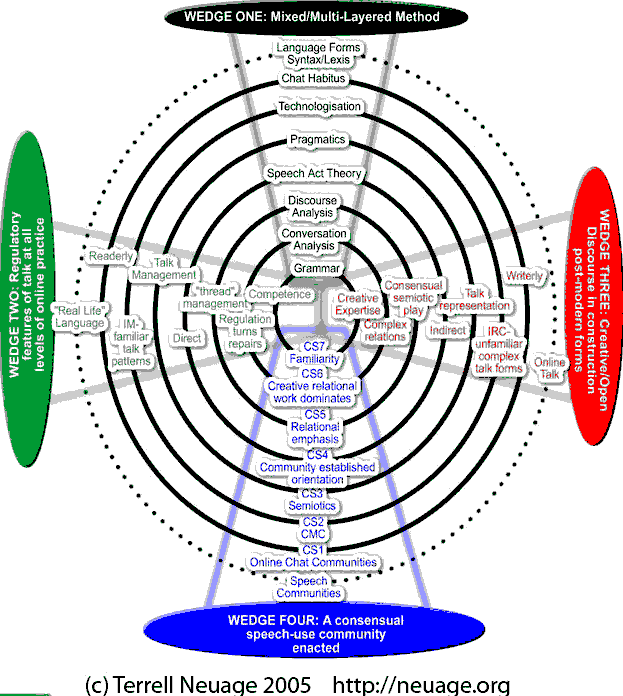
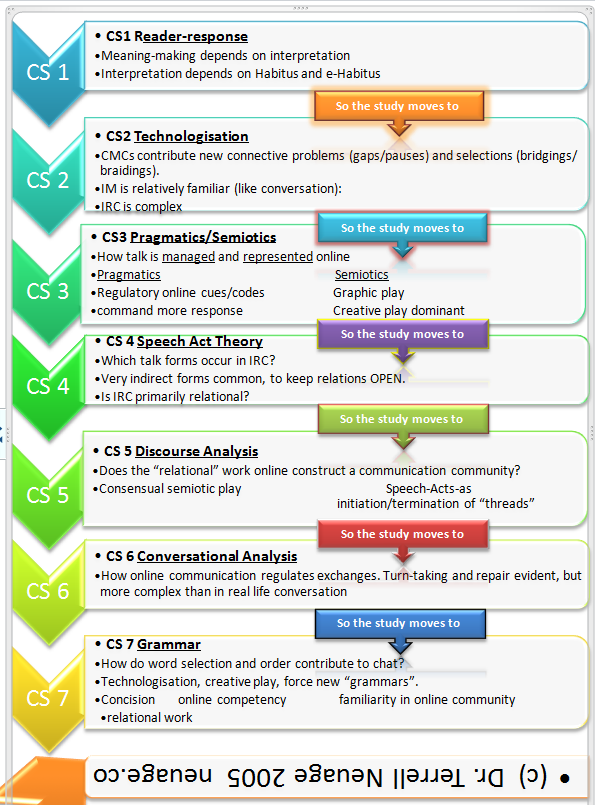
To test ways in which these new communicative forms might be examined and understood, in this study, I capture and sample a moment in time of on-line exchange behaviours, and look at them through the lens of a wide range of linguistic and discourse theories. Using these theories demonstrates how, despite the differences in “chat” conducted on-line from that carried out face-to-face, on-line chat and “natural conversation” share some features. Analytical theories developed for inquiry into both conventional speech and print-based text reception, can be used for examining on-line chat, and are able to produce findings which help explain these new communicative acts. The seven case studies and the theories and associated methodologies used to assess are as follows:
- Disaster Chat (Hurricane Floyd): Beginning with Reading Response Theory as a text-based analytical tool, this Case Study of a natural-disaster-based chat site shows that in on-line chat, both the person writing and the one (or many) reading are co-language-meaning creators.
- Instant Messenger: Using the one-on-one talk relation of the Instant Messenger system, this Case Study focuses on the technologisation of online talk, and its foundation in the ideas behind Computer Mediated Communication. I approached this case study with two questions related to Computer-mediated communication: “Do computers change conversation?” and “Are Instant Messenger chatrooms closer to off-line-person-to-person conversation than the multi-dialogue found in a multivoiced chatroom? ” The findings suggest that computers do indeed change conversation, and that Instant Messenger chat is closest to person-to-person communication – but that even here, the “texted” nature of the talk has produced differences.
- Celebrity Chatrooms (Britney Spears): In this Case Study the high levels of text-graphic fusion elements and abbreviations invited a Semiotic analysis; unexamined on-line communication’s potential to evolve cross-communicative formats. This study reveals analysis within the same repertoire of images, words and mixed-mode forms, such as specific “chat community” conventions of abbreviation.
- Astrology Chatrooms: Here, Speech Act Theory is used to examine the practical and goal-related uses of online language, and so extends the study into how chat participants on-line direct their communicative activities towards social actions – and whether these vary in the on-line world from those used off-line.
- General Chat: To assess how the more open chat communities entering general-topic chatrooms on a less regular basis, make sense of the chat behaviours present, it is important to understand exactly what it is that arriving chat participants “read” from the online texted-talk on screen. Discourse Analysis examines the message structures organizing an on-line community into consensual, resistant or negotiative communicative moments. In the case of General Chat it is able to assess how the communicative elements appearing on the screen provide participants with the general or generic “cues” to enter and participate in a conversation.
- Computer Chat (on the topic of expert software WEB3D): This case study asks does an expert community chat-site operate in the same conversational environment as general chat participants, or as in sites offering focused talk relations among strangers. Conversational Analysis, used to examine the structuring rules of natural or real-world conversation, has uncovered regulatory behaviours in talk, such as ways to perform sequential organization of talk, allocate turn-taking and negotiate repair to conversational break-down. CA is able to depict interactional competence in conversation. This Case Study examines how useful it might be in reading the rules of chatroom talk.
- Baseball Chat: Here an informal “expert” group, with regular and casual users intermixed, is examined, to test whether the specialist forms used to demark a specific chat “community” are annexed in from outside “natural” baseball chat, or evolve new online “baseball chat” forms of their own. This study applies techniques for describing grammatical systems drawn from a number of Linguistic Schools, to examine how many of the common grammatical conventions – such as word order, sentence structure, question formation, do not hold up in on-line chat. Further: baseball-chatters on-line do not use the same specialist formations as their off-line brethren – raising interesting questions as to the special pressures of online chat, even in very specific talk communities with strong offline conventions in their speech.
Other chat samples saved and referred to in this thesis to enhance and support points include: 911 Chat, Afghanistan Chat, Bondage Chat, CNN News Chat on 911 and Christian Chat.
Electronic communication has opened a new realm for communication – both as necessary information exchange, and as social play and psychological development of self/selves. With continually evolving innovations enabling new communicative activities, we must anticipate new and unpredictable – even as yet indescribable – communicative behaviours and understandings. By applying more detailed forms of textual analysis to the actual examples of computer mediated communication (CMC) my project sets out to detect new modalities as they evolve.
Chat on-line is “global” only to the extent of accessing many varying “local” structuring references. A “global” or universal “chat speak” is not evident in on-line talk selections – for all the emergence of expressive repertoires in netiquette, emoticons or IRC/SMS abbreviation. In this study, I suggest that what is evolving here is not – or not yet – separated from speech in the physical world, to the extent of disconnection from dominant discursive framings: that on-line texted-talk “chunks” its interactions in familiar ways. I am also suggesting however that at the level of “chat” or interpersonal interactivity, new behaviours abound.
Declaration
I declare that this thesis does not incorporate without acknowledgement any material previously submitted for a degree or diploma in any university; and that to the best of my knowledge it does not contain any materials previously published or written by another person except where due reference is made in the text.
All transcription from the Internet was undertaken by the author/candidate.
All chat logs are on the accompanying CD. They are listed under the name of the case studies they are used in, for example, the log for case study 1 is called 1a on the CD.
Terrell Neuage
Tuesday, 3 August 2004
Acknowledgements
My appreciation and thanks for the accomplishment of this study are directed to Dr Jackie Cook for her years of patience and guidance of this thesis. Without her this would not have been possible. I am much in debt to Dr Cook, of the department of Communication, Information and New Media at the University of South Australia, who read many re-written manuscripts with an eagle eye, often at the other end of an Internet connection, answering what seemed to be unanswerable questions and supplying desperately needed assistance and suggestions.
I also thank Associate professor Maureen Nimon for keeping me on track and giving valuable advice and Professor Claire Woods, School of Communication, Information and New Media for guidance and reading of this work.
And I thank my wife, Narda Biemond, for putting up with my doing this thesis year after year and for her suggestions and support.
I dedicate this thesis to my sons, Sacha and Leigh Neuage, who began the process of online communication with me in the mid-1990s. Sacha’s creative and free spirit has led him to achieve wonderful things in the world of art and music. As a critical thinker, he has challenged me often to dig deeper, and to further explore my own position on many issues. Leigh was a baseball player for Australia and for the Los Angeles Dodgers. Leigh died on 16th August 2003 at the age of 20, at the same time I was completing this. Many people whose lives he impacted remember Leigh’s generosity and kindness to others in an electronic guest book. I was a single parent with two boys, aged 14 and 17, when I started this thesis in 1998. We all questioned whether there would ever be a completion date for this and now I have come this far. My two sons, Sacha and Leigh, have been my primary motivation for the past 20 years to succeed.
Thanks folks.
© Dr Terrell Neuage 2025, Adelaide, Australia