Wednesday
Wednesday week 9
See pages 338 to 339 and 208 - 209
9.13 –outlining video
9.20 – 9.25 handout discuss evaluation sheet
9.25 – 9.40 notes below
9.50 – 10 Report 4 and Kennedy speech
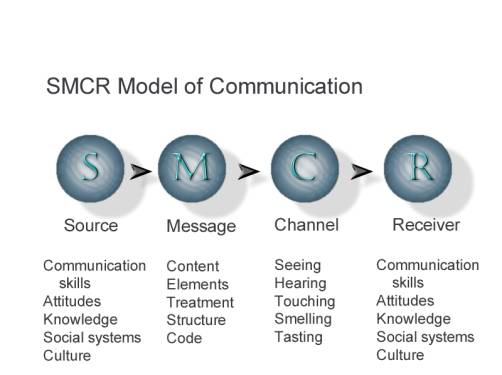
Berlo's Model Source - Message -Channel - Receiver.
I. Berlo's (1960) SMCR Model of Communication
David Berlo's proposes that there are five elements within both the source/encoder and the receiver/decoder, which will affect fidelity (Faithfulness to obligations, duties, or observances.).
As you will see from what follows, Berlo enumerates what are the factors to be taken into account at each 'end' of the communication. Thus, for example, in principle, the more highly developed the communication skills of the source and the receiver, the more effectively the message will be encoded and decoded. In fact, however, the relationship between skill level of receiver and source needs to be taken into account, since, as Berlo points out:
A given source may have a high level of skill not shared by
one receiver, but shared by another. We cannot predict the success of the
source from his or her skill level alone.
Berlo (1960)
A basic approach to the communication act would tell us much about the communication skill level, personal characteristics etc. of both source and receiver. In doing so, it might tell us about the general competence of both, but it doesn't allow us to make any firm predictions about the likely success of the communication. The communication studies teacher may have a seductive tone of voice, may be considered by the students to be 'one of them', may have expert and wide-ranging knowledge of communication theory, may have great enthusiasm for the subject; the student may be highly intelligent, articulate, literate and diligent. However, if the student finds communication theory pointless, boring and a load of hot air, then, clearly, fidelity will be far less than desirable.
Practical work
Berlo's model is a very useful point of departure. It may transpire as you progress in communication studies that there are many points, various assumptions which you could challenge Berlo on, but his model does have the merit of drawing our attention to the unpredictability of communication and does draw our attention to at least some of the factors which make it unpredictable. As such, it can serve as an excellent broad framework for your audience research.

INTRO
AND CONCLUSION SHOULD BE ABOUT 15% TOTAL
BODY =
85%
OUTLINE
STAGES
FIRST
OUTLINE = PREPARATION
FORMAL
OUTLINE – WITH YOUR BIBLIOGRAPHY –
KEYWORDS
intro
BODY
Select
pattern
Info-time
sequence – chronological
Climatic
builds
- Time sequence to a certain event
- Start as a child
- as a teenager
- as an adult
- Spatial relations
Give
audience a tour
- cause and effects
- topical sequence – no importance on
sequence
- advantages
- disadvantages
- types
- reasons to favour or
to disfavour
- climatic or anticlimactic – builds to a
dramatic conclusion
- Problem solution organization pattern –
the way you frame the problem will depend on point of view
Take our
pattern and put it into your outline
DIVISION
SUBPOINTS
COORDINATION
SUBPOINTS
PARALLELISM
SUBPOINTS
PROBLEM
SOLUTION
we make persuasive speeches
for three reasons
- to inspire
- to move to action
- to convince
Using media to extend the five basic senses: touch, sight, sound,
taste, and smell
POINTS TO CONSIDER
Never try to convey more than one idea on a visual medium
For overheads need at least an 14 -point font to see in
this room
Video – no more than two-minutes –
Models – be sure we can see them
Poster boards – careful that we can see what you are saying
Flip Charts – usually used in a business meeting
Audio –
Slides – photos – if from the Internet etc save as a .jpg file
and save to a disc
Over reliance on visual media, sometimes to the point of overkill
Too much information crammed on a single hard-to-see visual
Wrong type of presentational media to achieve the purpose
Make it as a complement to speech -
Powerpoint
Use graphs and pie charts
- Outlining
- Organization
Language
p.220 “Building a speech”
Avoiding euphemisms
Write the words disability, handicap, and challenge on the
board. Ask students which of these terms they believe is preferable for
referring to students who receive special education (tell them not to respond
aloud with their choice). After a minute or two, ask for a show of hands
regarding which term students prefer. Write the number of "votes" each
term receives on the board. Now ask at least one student who chose each term to
explain the reasons for his/her choice. (It has been my experience that the
majority of students will choose "challenge" because they think it is
the most "positive.")
Teacher Presentation: Explain to the students that disability has become the generally accepted term, having replaced the word handicap in federal laws (e.g.
Individuals with Disabilities Education Act instead of the Education of all
Handicapped Children's Act). Ask if anyone knows why. Some students may have
heard that the origin of the word handicap has something to do with being a
beggar (i.e., having cap in hand, ready for donations). However, the word
actually is derived from an English game in which money was held in one's cap
(Miriam Webster Online Dictionary). The actual reason for the change is more
difficult to ascertain, but is probably related to the definitions of the two
words
A disability is a measurable impairment or limitation that "interferes with a person's ability, for example, to walk, lift, hear, or learn. It may refer to a physical, sensory, or mental condition" (Schiefelbusch Institute, 1996).
The word handicap is not a synonym for disability. Rather, a handicap is a disadvantage that occurs as a result of a disability or impairment. The degree of disadvantage (or the extent of the handicap) is often dependent on the adaptations made by both the individual and society (Department of Physical Medicine and Rehabilitation, 2000). Therefore, the extent to which a disability handicaps an individual can vary greatly. For instance, a person who uses a wheelchair would be much less "handicapped" in a building that is wheelchair accessible than one that is not.
In comparing the two definitions, disability seems the better choice for describing a person's condition, particularly in a usage such as "a child with a disability," which would conform to the current trend of using people-first language.
People-First Language? Just as the term would imply, this language trend involves putting the person first, not the disability (e.g. a person with a disability, not a disabled person). Thus, people-first language tells us what conditions people have, not what they are (Schiefelbusch Institute, 1996). Other suggestions for referring to those with disabilities include:
- avoiding generic labels (people with mental retardation is preferable to the mentally retarded);
- emphasizing abilities, not limitations (for instance, uses a wheelchair is preferable to confined to a wheelchair);
- avoiding euphemisms (such as physically challenged) which are regarded as condescending and avoid the real issues that result from a disability;
- and avoiding implying illness or suffering (had polio is preferable to is a polio victim, and has multiple sclerosis is preferable to suffers from multiple sclerosis) (Department of Physical Medicine and Rehabilitation, 2000; Schiefelbusch Institute, 1996).
Kennedy video for report 4b
Report 4 b and 4 c do in group