Instructor Dr. Terrell Neuage
at Albany Academy and Albany Academy for Girls
 return
to computer courses at Albany Academies
return
to computer courses at Albany Academies
Daily Notes ~ Calendar ~ Blog ~ Wiki ~ Gif Stories ~ Flash Poems
Course Description: This is an introductory course on experimental computer writing using hypertext, digital storytelling, Online WebPoetry as well as student's critiques of hypertextual literature already produced. We use the hypertext writing environment, Storyspace from Eastgate.
Our course, Computer Writing, looks at electronic narrative. Firstly, we will work with hypertextual writing. Hypertext is non-linear and multi-linear narrative that is linked according to the witness of the story.
In essence, the reader becomes the writer-narrator, following self-chosen links. Hypertext writing shares some interesting features with folk storytelling traditions, for example, Native American due to its digressive elements (stories within stories); what is called "a story" is really a Web of stories, and like oral telling, in hypertext, no two explorations of a hypertext narrative are exactly the same for readers. In hypertext the focus is on the reader and the appearance of choice and some determination of how to read, as every part of a hypertext narrative presents multiple choices for the direction and sequence of reading.
We will be reading and critiquing five stories (Samplers, Deena Larsen; Victory Garden, Stuart Moulthrop; We Descend, Bill Bly; Patchwork Girl, Shelley Jackson; and Marble Springs, Deena Larsen) from Eastgate publishers (http://www.eastgate.com) then we will create our own hypertextual stories in the program ‘Storyspace’.
Later in the course we will explore digital storytelling which is the use of images and animations to tell a narrative. We will be using Macromedia Flash (examples of poems made in Flash) and Ulead’s gif animator to create electronic poetry and self-reflective diaries of alternative selves.
Grading:
50 % Five "hypertextual projects". You will have two class periods for each "project" [we may change this to more or less time once we are involved] to read - maneuver through the landscapes of the "project" then one class period to write up your reflections on it. I will provide guidelines for this. These responses will be uploaded to our blog. There will be two entries for each "project". One of your original reflections and one responding to what someone else in our course has written about a "project". Each "project" is worth ten-points; five for your critiquing and five for your response to what someone else has written on a "project". SEE CRITIQUING HYPERTEXT
25 % You will do one project for a grade, which must be done on StorySpace. I will provide the guidelines for this but it will be about an alternative-self.
25% Other Projects:
5 % = 1. Making a short hypertext poem in Word about a day in the life of you when you were a tree.
5 % = 2. Making a short hypertext poem in Flash
5 % = 3. Making a short hypertext poem in Kurzweil CyberArt's program
10 % = 4. Make a group project
Our sources are:
Hypertext is text which contains links to other texts. The term was coined by Ted Nelson around 1965 (see History ).
HyperMedia is a term used for hypertext which is not constrained to be text: it can include graphics, video and sound , for example. Apparently Ted Nelson was the first to use this term too.
Hypertext and HyperMedia are concepts, not products.
See also:
#Thoughts in Quarantine Images: Twitter ~ Tumblr ~ Pinterest ~ linkedin ~ Flickr (2020) / Flickr (pre-2019)
Behance Project - Thoughts in Semi-Isolation June 2020
current books by Terrell Neuage
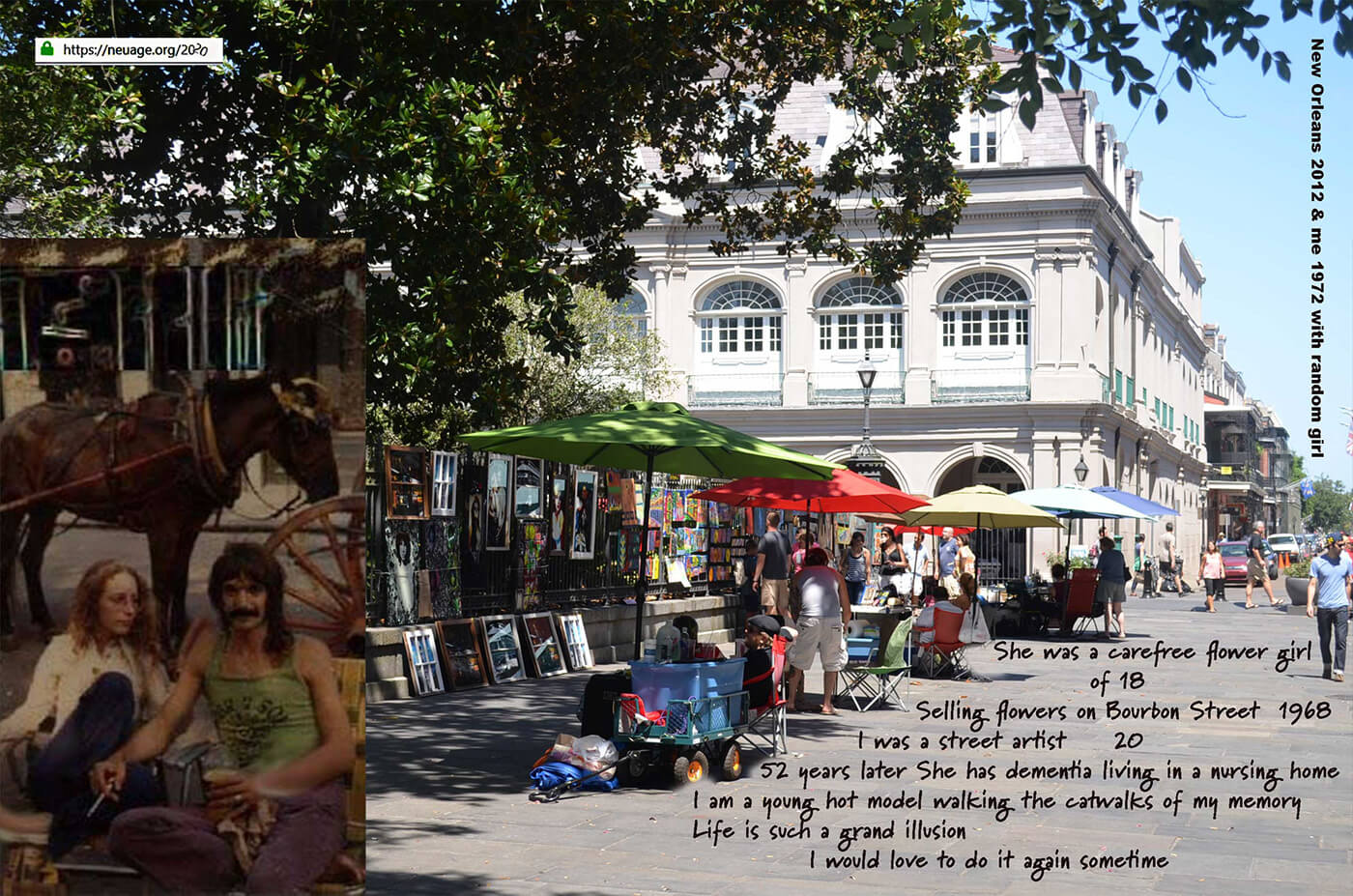
She was a carefree flower girl of 18
Selling flowers on Bourbon Street
1968
I was a street artist...
WE ARE HERE - due to omicron & worries about borders we have moved our trip forward by a week - Lahore Pakistan arrived the fourth of December. See ya soon, on our (covid) 15-week world tour: Abu Dhabi (UAR), Lahore Pakistan (December 4 - 22), Istanbul Turkey (December 23), Washington DC (December 24 - 30), New York City (December 30 - 31), Oneonta New York (January 1 - 4), Washington DC (January 4 - 17), Nieuwerkerk aan den Ijssel & Utrecht Netherlands (January 18th) return to Australia late March 2022 [what could possibly go wrong] See our photos in Facebook -
our first video clip 'going for a bit of a shop in Lahore'
#DailyThoughts as of 11 December2021
#OurCurrentLifeWithCovid as of (DST) - 11 December2021 Lahore PakistanHAPPY 74TH BIRTHDAY TO ME one-hundred-twenty-four days ago
how we see the world today
youtube videos 28 April 2021 (Melbourne - background music coming soon)
~
All Images of picture poems
Terrell Neuage (Adsit) ~
update 10 December 2010
https://youtu.be/e27KPscnQkM
'Travel with my ties in Isolation' Album on Behance
A cautionary tale
Ties in Isolation
e-books
contact me ~ My Resume
HOOM video (1969 - 1978 photos)